

The Pixel 11 has been in shops since 20 August, which means the first ones are already coming back to us with a cracked corner. That's how it goes with every launch. We don't sell Pixels. We're the bench at K10, DFO Uni Hill that fixes them after the first drop, so this isn't a review. It's what's genuinely new, what it costs in Australia, and the part the launch event skipped: how easy one is to repair, and what that'll mean for you. And yes, before anyone asks, we fix Pixels. Every generation, every fault.
What Google actually confirmed
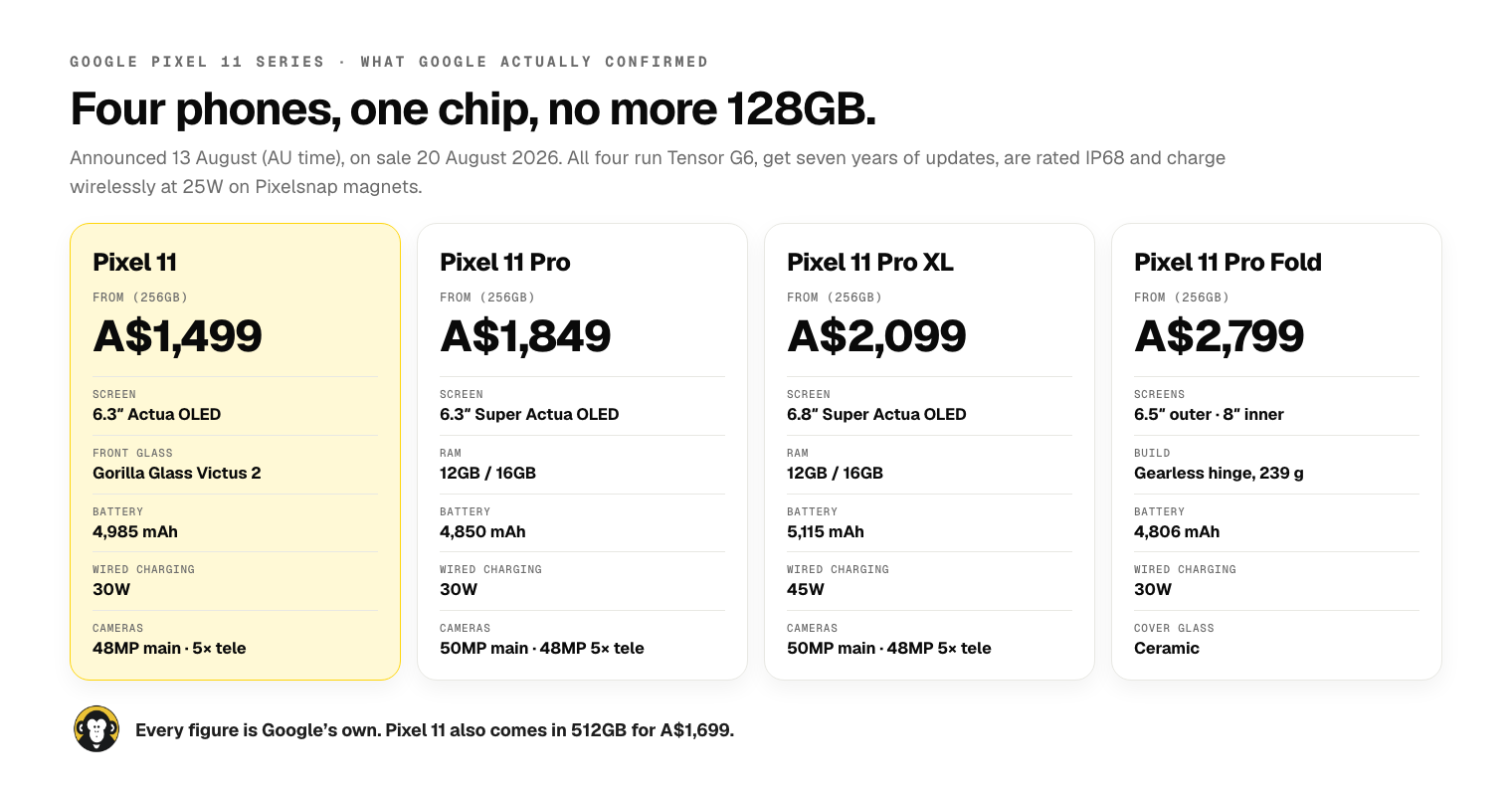
There are four phones: the Pixel 11, 11 Pro, 11 Pro XL and 11 Pro Fold. All four run the new Tensor G6, all four are rated IP68, and all four get seven years of software and security updates. Google has also dropped the 128GB base model, so every Pixel 11 now starts at 256GB. Here's the line-up at a glance.
The Aussie prices
The Pixel 11 starts at A$1,499 (A$1,699 for 512GB). The 11 Pro is A$1,849, the Pro XL is A$2,099, and the Pro Fold is A$2,799, climbing to A$3,349 for 1TB. The Pro XL and Pro Fold are both A$100 up on last year. Losing the 128GB model means the cheapest way into a new Pixel costs more than it used to, even where the headline number looks familiar.
What's actually new
Tensor G6 is the big internal change. Google claims 15% quicker app launches and a much faster on-device AI engine, and we'll leave the benchmarking to the reviewers. The base Pixel 11 keeps a 5× telephoto and gets a bigger 48MP main sensor. The Pro XL moves up to 45W wired charging. The Pro Fold loses almost 20 grams, gets a gearless hinge and a ceramic outer cover glass, and Google says it's three times more durable than last year's Fold. Every model charges wirelessly at 25W on Pixelsnap, Google's magnetic system, which matters for back-glass repairs. More on that below.
How repairable is it, really?
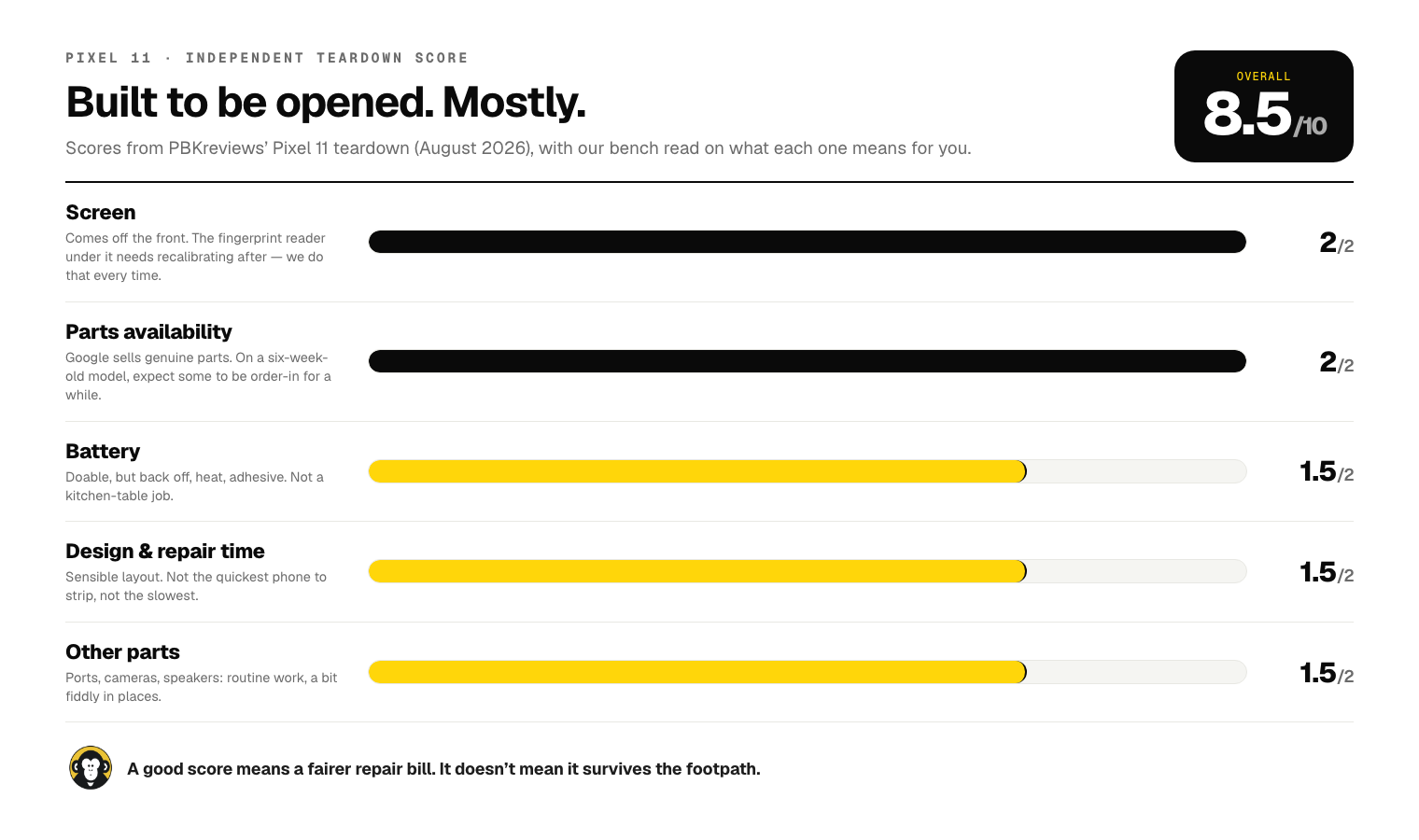
This is the good news, and it's a genuine point in Google's favour. An independent teardown by PBKreviews gave the Pixel 11 8.5 out of 10 for repairability. The screen and parts availability both got full marks, and the battery lost half a point. That fits what we've seen from Pixels on our bench for years: Google builds them to be opened.
The screen comes off the front
This one matters more than it sounds. On a Pixel, the display comes away from the front without the back and the rest of the phone being pulled apart first. Fewer steps means less risk, less time on the bench and a fairer bill. The one catch is the under-display fingerprint reader. It sits beneath the panel, and after a screen swap it has to be recalibrated to the new display. Skip that and the fingerprint unlock gets flaky or stops working. Some cheap repairs skip it. We don't, and we test unlock before the phone goes back to you.
The battery: doable, not a DIY weekend
The battery is the one repair that isn't easy. To get to it you have to lift the back panel off with heat, work through adhesive and then re-seal it properly. It's routine for us. It's also the job we'd gently steer people away from trying at home with a hair dryer and a guitar pick, because a punctured lithium cell is not a fun afternoon.
Seven years of updates is great. It also means most Pixel 11 owners will outlive their first battery. Plan for it the way you'd plan for tyres.
That's the quiet consequence of Google's seven-year promise. The software will keep going long after the original cell has faded, and in our experience a phone battery is usually tired somewhere around years two to four. We wrote up the honest version of when a battery is genuinely worth replacing. It's iPhone-focused, but the rules of thumb apply to a Pixel too.
What a Pixel 11 repair looks like on our bench
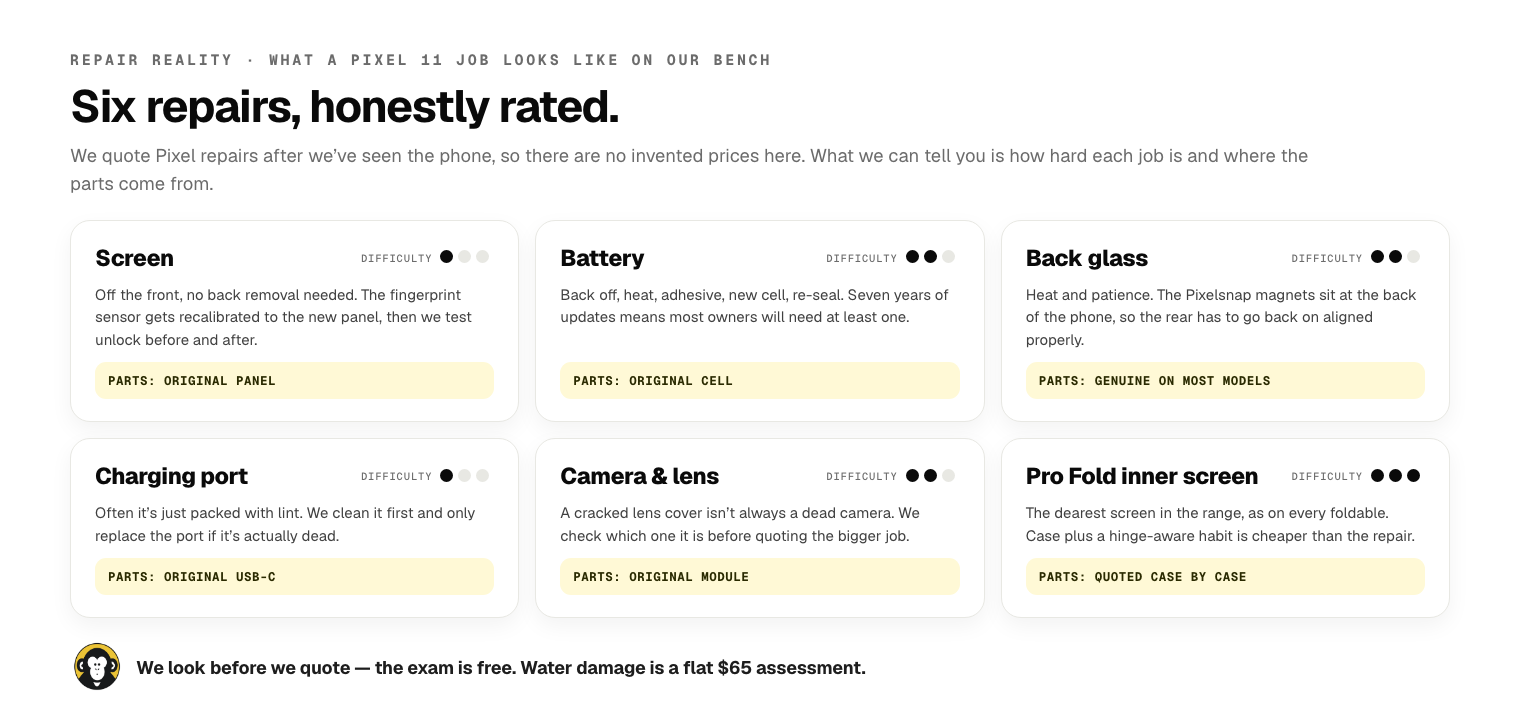
Here are the six jobs we expect to see most, rated honestly for difficulty, with the parts we fit.
Original parts, plain and simple
Here's where Pixel makes life easier than iPhone. Google makes genuine screens, batteries, charging ports and camera modules available, so that's what we fit. There's no aftermarket-grade debate to have. Back glass and camera lens glass are genuine on most models too, and on the few where a genuine part isn't available, we tell you before we start and fit a quality aftermarket one.
One honest caveat for right now: the Pixel 11 is about six weeks old. In the first months after any launch, parts for a brand-new model can be order-in rather than on the shelf. If yours needs something today, we'll tell you at the quote whether it's same-day or a short wait for the part. We won't find out halfway through the job.
Back glass and the magnets
Pixelsnap's magnets live at the back of the phone, so a back-glass repair isn't only about the glass. The rear has to go back on properly aligned and sealed, or your magnetic charger and accessories won't sit right. It's a heat-and-patience job, not a hard one, and it's exactly the kind of detail a rushed repair gets wrong.
The charging port: check the lint first
Plenty of phones that come in with a "dead" port aren't broken at all. The port is packed with pocket fluff and the cable can't seat properly. We clean it first, for free, and only replace the port if it's genuinely failed. Charging you for a part you didn't need is a good way to never see you again. There's more on that in what 13 years of charging ports taught us.
The Pro Fold: the one to protect
Every foldable has the same weak spot: the big inner screen is the most expensive part in the phone, and it's soft by nature. Google's claims about a tougher Fold are welcome, but a folding panel is still a folding panel. We quote Fold screens case by case once we've seen the damage. If you've got one, the cheapest repair is the one you avoid. Use a proper case, keep grit out of the hinge, and never close it on a pen or earbud. We covered the same trade-offs on Samsung's Fold8, and most of it applies here.
IP68 is a rating, not a promise
All four models are rated IP68, which is a lab result on a factory-sealed phone. It doesn't make any promise about a phone that's been dropped twice or had its screen or back off. Treat it as protection against rain and a spilled drink, not permission to take it in the pool. If yours does get properly wet, power it off, don't charge it and skip the rice. We start with a flat $65 water assessment and quote the actual repair before going further.
So what will it cost to fix?
You'll notice there's no price list in this post. That's deliberate. We quote Pixel repairs after we've seen the phone, because the model, the part and exactly what's broken all move the number, and we'd rather give you a real figure than a teaser that grows at the counter. What we can promise is how it works. We look before we quote, and the exam is free. If we can't fix it, you don't pay for the attempt, and every repair carries a minimum 90-day warranty on parts and labour.
If you're weighing whether a crack is worth fixing now or can wait, we've written that up too: cracked but still working, fix now or risk it? For everything Pixel, from the original Pixel through to the 11 series, the Pixel repair page has the full rundown.
The honest bottom line
The Pixel 11 is one of the more repair-friendly flagships you can buy right now. The screen comes off the front, genuine parts exist and seven years of updates give it a real long life. That's a good thing for your wallet and for the amount of e-waste in the world. It still isn't unbreakable, the battery will still wear out, and a Pro Fold's inner screen is still the priciest mistake in the line-up. Buy a case with raised edges on day one.
When yours needs something, bring it in. You can get a quote in 60 seconds or see everything we fix on the repairs page.
03 9467 9694 · K10, DFO Uni Hill, 2 Janefield Drive, Bundoora · open every day, 10:00am – 6:00pm


Be the first to comment — or if you'd rather just ask us in person, walk in to DFO Uni Hill any day 10–6.