

Apple has just put a mechanical aperture in a phone camera. Six physical blades, moving between four f-stops, inside something you'll eventually drop on a tram platform. That's the headline on the iPhone 18 Pro and iPhone 18 Pro Max — on sale here Friday 18 September, starting at A$2,099. We don't sell phones. We're the bench at K10, DFO Uni Hill that fixes them after the honeymoon, so here's the version you won't get from the keynote: what's genuinely confirmed, what it costs in Australia down to the dollar, and an honest read on what it'll cost to repair.
What Apple actually confirmed
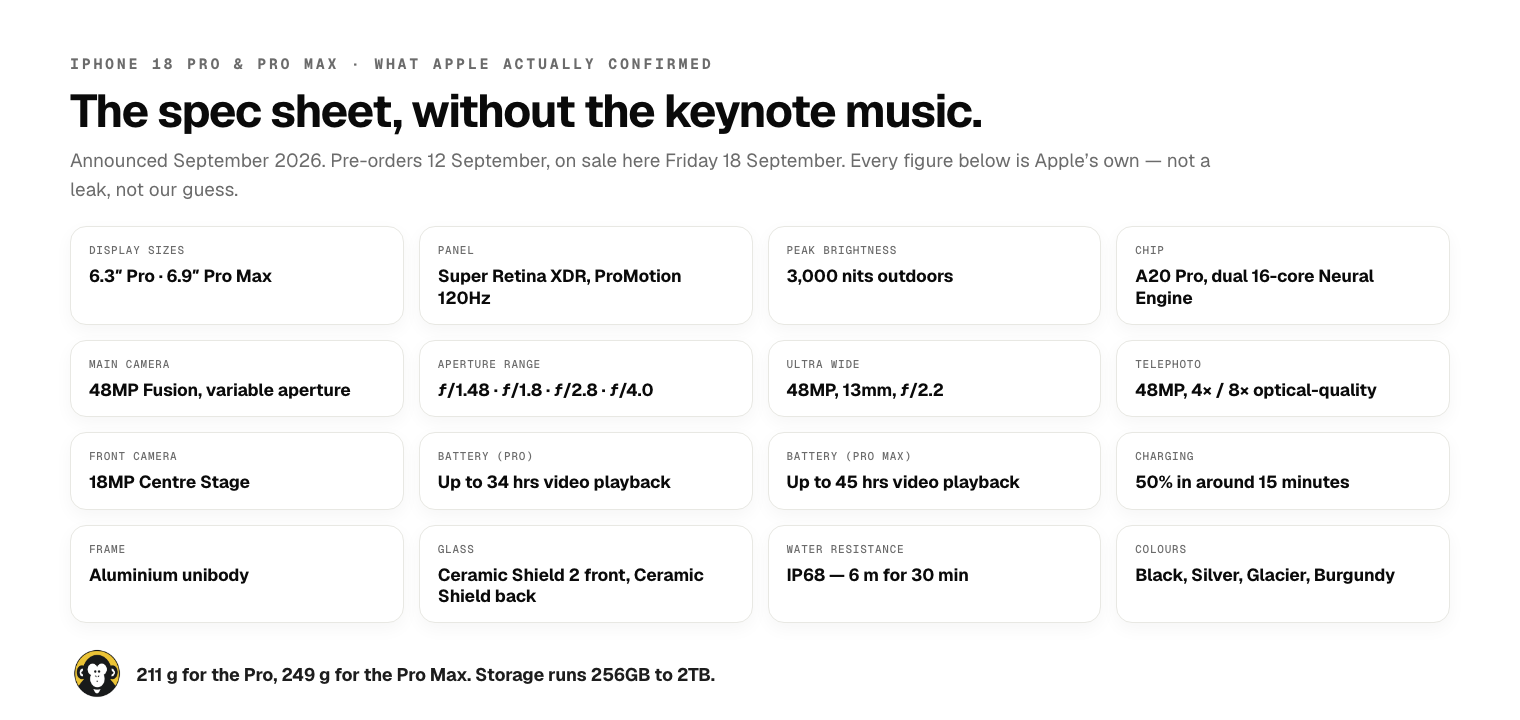
Both models keep the sizes you know — 6.3″ on the Pro and 6.9″ on the Pro Max — and both keep the forged aluminium unibody that arrived with the 17 Pro. The chip is the A20 Pro, the peak outdoor brightness is 3,000 nits, and there are four finishes: Black, Silver, Glacier, and a new hero colour, Burgundy. Here's the full sheet.
The camera is the actual story
The 48MP main camera now has a variable aperture — a six-blade mechanism that physically opens and closes between ƒ/1.48, ƒ/1.8, ƒ/2.8 and ƒ/4.0. That's a real camera part, the kind that has lived in DSLRs for decades, shrunk into a phone. Photographically it's excellent: genuine control over depth of field instead of a software blur guessing where your subject's hair ends.
From where we sit, it's also the first moving part Apple has added to an iPhone camera. We're not predicting doom — we have no bench data on it and won't pretend otherwise. We're just noting that grit, moisture and a hard corner drop do different things to a mechanism than they do to a fixed lens, and that nobody, Apple included, has a year of real-world failure data on this yet.
“Three times the scratch resistance” is not what most people think it is
The front is Ceramic Shield 2, which Apple rates at 3× the scratch resistance of the iPhone 16 Pro. That's a genuine improvement and it'll keep your screen looking newer for longer. It is also not the thing that breaks phones. In thirteen years on this bench, the number of screens we've replaced because someone scratched one to death rounds to zero. They break because they hit concrete, corner-first. Scratch resistance and impact resistance are two different properties, and only one of them is in the marketing.
What it costs in Australia
Here's the number everyone actually wants.
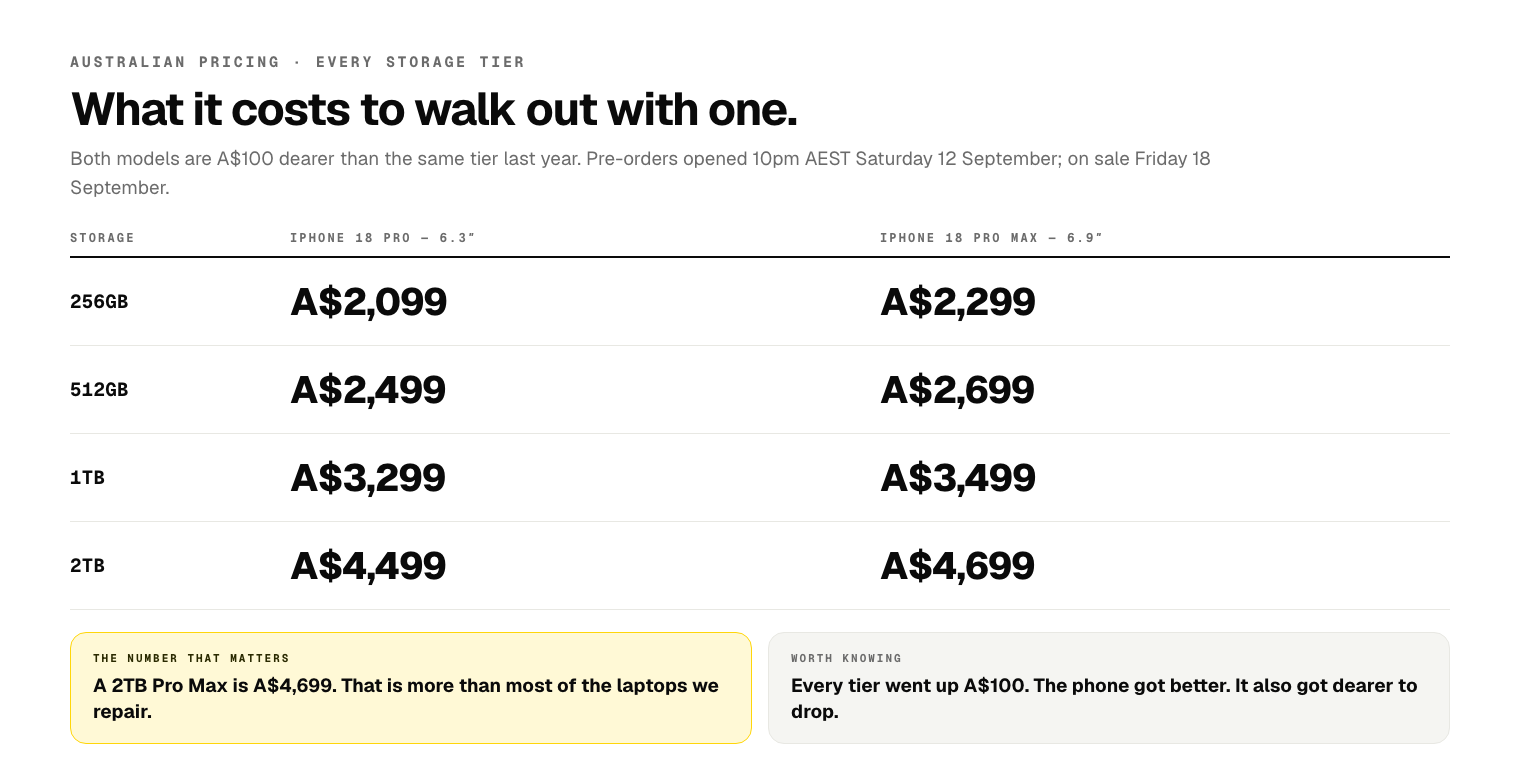
Every tier is A$100 up on the equivalent model last year. The 256GB Pro starts at A$2,099 and the 2TB Pro Max tops out at A$4,699 — more than most of the laptops that come through our door. Pre-orders opened at 10pm AEST on Saturday 12 September; they're in stores Friday 18 September.
A phone that costs more means a repair bill that matters more, and a year in which the parts to fix it barely exist. That's not pessimism. That's just what launch month looks like from the bench.
Now the bit the keynote skips: what it costs to fix
We want to be straight about something before this section. Nobody has repaired an iPhone 18 Pro yet, including us. It isn't in customers' hands until 18 September. So we're not going to publish a price list for it and pretend we've got bench hours behind the numbers.
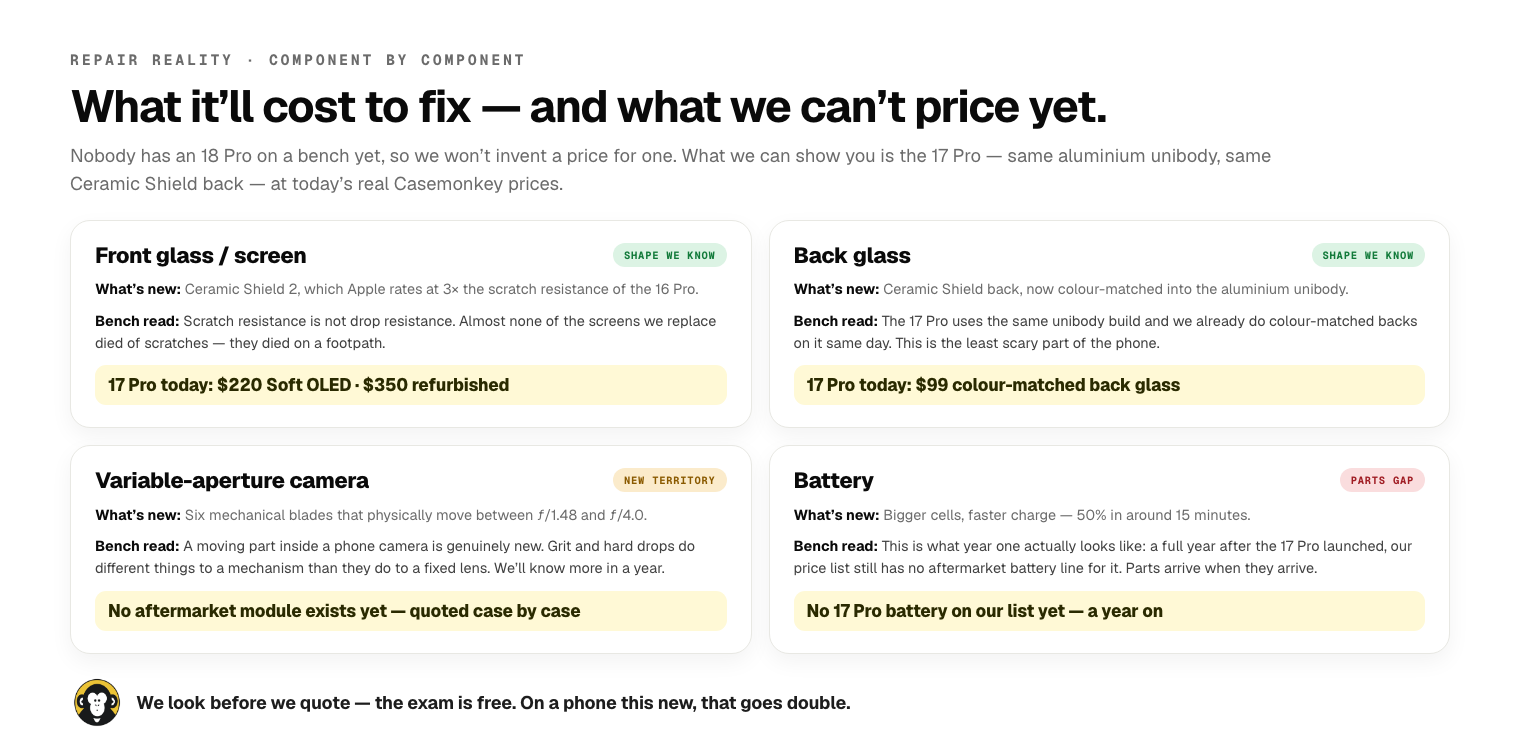
What we can do is show you the closest honest comparison we have: the iPhone 17 Pro, which shares the same aluminium unibody and the same Ceramic Shield back, at today's real Casemonkey prices.
The screen: a shape we know
Screen replacement is the repair we do most, and the 18 Pro doesn't change the shape of that job. On a 17 Pro today, a top-tier Soft OLED is $220 and a refurbished panel is $350, both same day. If you want the honest breakdown of what those grades actually mean — and why a "$89 OLED" advertised down the road is a different product entirely — we wrote that up in detail in what "$89 OLED" actually means.
The back glass: less scary than it looks
Ceramic Shield on the back, colour-matched into the aluminium body, sounds like a nightmare to service. It isn't. The 17 Pro is built the same way and we already do colour-matched back glass on it same day for $99. Expect the 18 Pro to land in similar territory once parts flow.
The battery: a live lesson in what year one means
This is the part worth paying attention to. The iPhone 17 Pro launched a year ago. Our price list still has no aftermarket battery line for it. Not because we can't do the job — because the quality aftermarket cells we're willing to put in a customer's phone haven't reached the market at a price that makes sense. We could fit something cheap and nasty tomorrow. We don't, and we're not going to start.
That's the honest cost of buying a phone in its first year: for roughly twelve months, an out-of-warranty repair means Apple's own parts at Apple's own pricing, or waiting. It applies to the 18 Pro exactly as it applied to the 17 Pro, and to the iPhone Duo we wrote up last week. Our approach doesn't change: original parts first, A-grade aftermarket second, and we tell you which one you're getting before we touch anything.
The charging port: the fault nobody plans for
Every launch we watch people budget for a screen and never once think about the port. It's the repair that creeps up on you: charging gets fussy, then you have to hold the cable at an angle, then it stops. On the 17 Pro that's a $160 job taking about 45 minutes, and on the 18 Pro we'd expect similar once parts settle. Worth knowing: more than half the "dead port" phones that come in aren't broken at all — they're packed with pocket lint, and a proper clean fixes them. We check that first, because charging you for a part you don't need is a quick way to never see you again.
IP68 is a rating, not a promise
Both models are rated IP68 — six metres for thirty minutes. That's a factory-fresh, lab-conditions number on a sealed phone. It is not a guarantee about a phone that's been dropped twice and had a screen out of it, and Apple's warranty has never covered liquid damage. Treat the rating as a buffer against rain and spills, not as permission to take it swimming.
So: upgrade, or fix the one in your pocket?
We're not going to talk you out of a new phone. If your 13 Pro is on its third summer and the battery dies by 3pm, an upgrade might genuinely be the right call, and the variable aperture is a real reason to want this one.
But run the numbers before you commit. A screen and a battery on an iPhone 15 Pro sits well under $400 on our list and buys you another two years. A 256GB 18 Pro is A$2,099 before a case, a screen protector, or the inevitable first drop. If your current phone's only real problem is a cracked screen or a tired battery, fixing it is usually the cheaper, less wasteful answer — and it keeps one more device out of a drawer.
If you do upgrade, there's no reason for the old one to sit in that drawer either. Our trade-in puts a real number on it in a few minutes.
The honest bottom line
The iPhone 18 Pro is a genuinely good phone with a genuinely interesting camera and a price that went up A$100 for the privilege. If you buy one, buy a case with raised corners on day one, because Ceramic Shield 2 will not save you from a footpath. And know that for the next twelve months or so, fixing it will mean Apple's parts at Apple's prices, whoever you take it to.
When it does need something — and eventually they all do — we'll look at it before we quote, and the exam is free. You can build a quote in 60 seconds for whatever you're carrying right now, or see everything we fix on the repairs page. Every repair carries a minimum 90 days on parts and labour.
03 9467 9694 · K10, DFO Uni Hill, 2 Janefield Drive, Bundoora · open every day, 10:00am – 6:00pm


Be the first to comment — or if you'd rather just ask us in person, walk in to DFO Uni Hill any day 10–6.