

Back in August we wrote up the rumours and guessed at something starting "around A$3,100+." Apple's own event on September 9 landed higher than that, and it finally has a real name: not Fold, not Ultra — iPhone Duo. It's Apple's first folding phone in the line's nineteen-year history, announced alongside the iPhone 18 Pro at Apple Park's "Surprise and Shine" event, and it goes on sale here on October 23.
We don't sell phones. We're the bench at K10, DFO Uni Hill, that fixes them once the honeymoon's over — so here's the version you won't get from the keynote: what's actually confirmed, what it costs in Australia down to the dollar, and an honest read on what a brand-new folding shape from a brand-new manufacturer means for repairs, written before a single one has reached a customer's pocket.
What's actually confirmed
Apple's design brief was clearly "make it disappear when closed and disappear again when open." A 5.4-inch OLED covers the outside; unfold it and you get a 7.6-inch foldable OLED, with a nano-texture matte finish offered as an option for the first time on an iPhone display. Here's the full sheet.
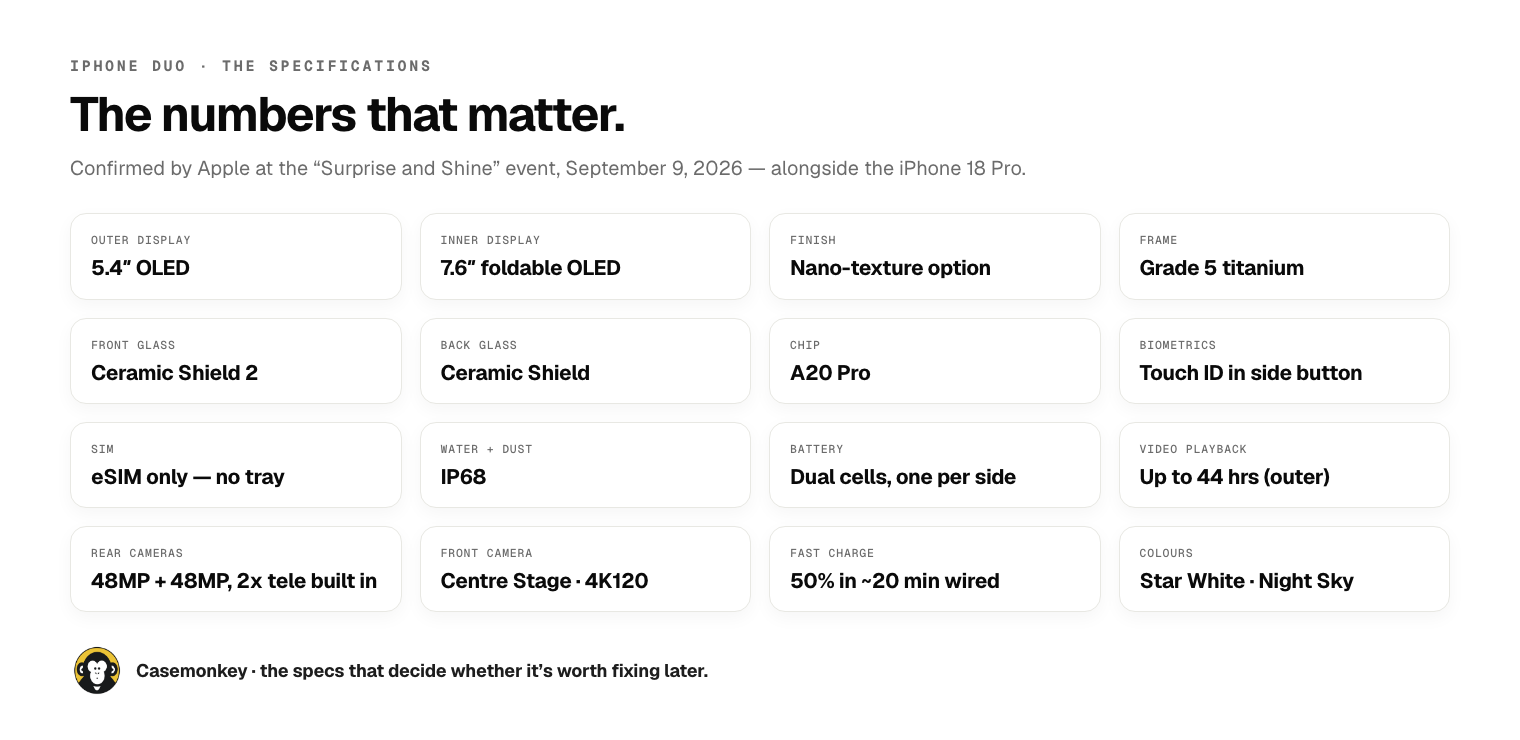
A few of those are worth translating out of marketing language. Touch ID in the side button, not Face ID, is the single biggest change to how you'll unlock an iPhone in over a decade — and it means the TrueDepth camera housing that's driven every Face ID repair since the iPhone X simply isn't there to worry about anymore. eSIM only follows the path Apple already took in the US, now applied worldwide on this model — no physical tray, no ejector pin, one less part to lose or break. And Apple is calling the hinge cover 3D-printed, with the phone described as the thinnest iPhone ever made when it's open — which, on a device with two batteries and a folding screen packed inside, is a genuinely impressive piece of engineering.
What it actually costs in Australia
Here's the number everyone actually wants: what it costs to walk out of an Apple Store with one.
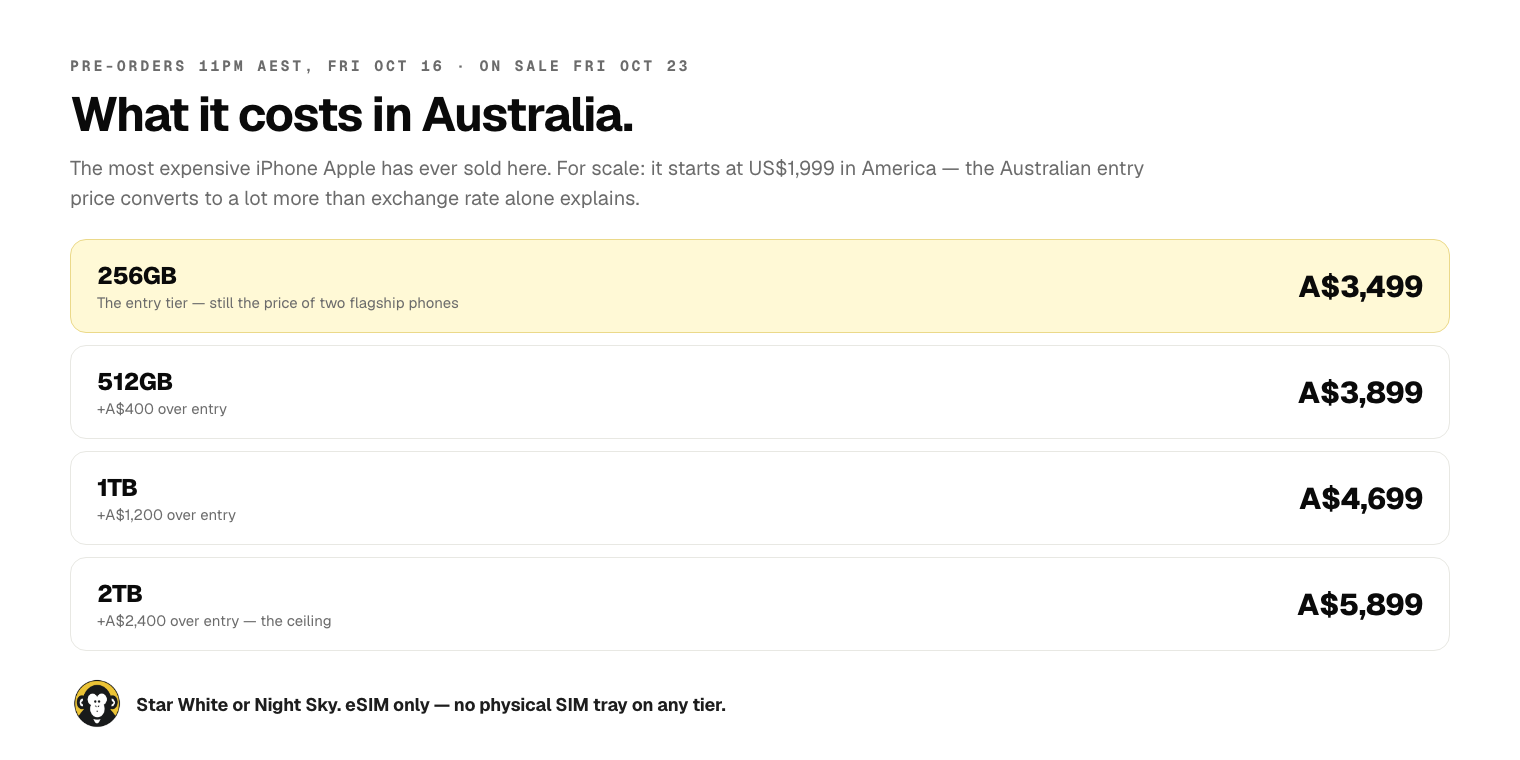
For context, the US price starts at US$1,999. Run that through the exchange rate and you'd expect something in the low-A$3,000s — not A$3,499. That gap between "what the currency conversion says" and "what's actually on the price tag" is the same story every generation of expensive iPhone tells, and it's worth knowing about before you're standing at the counter. It's eSIM-only across every tier, in Star White or Night Sky, and pre-orders open at 11pm AEST on October 16 for a October 23 launch.
The bit nobody at the keynote mentions: repairs
This is where a repair bench sees a launch differently to a reviewer holding a demo unit for twenty minutes. A fold is two screens, a hinge and — on this one — two batteries, which is roughly double the failure surface of a normal iPhone. We want to be upfront about something first: nobody has fixed one of these yet, including us. It isn't in stores until October 23. So take this section for what it is — not a review of the iPhone Duo specifically, but thirteen years of watching every other first-generation fold, applied honestly to this one.
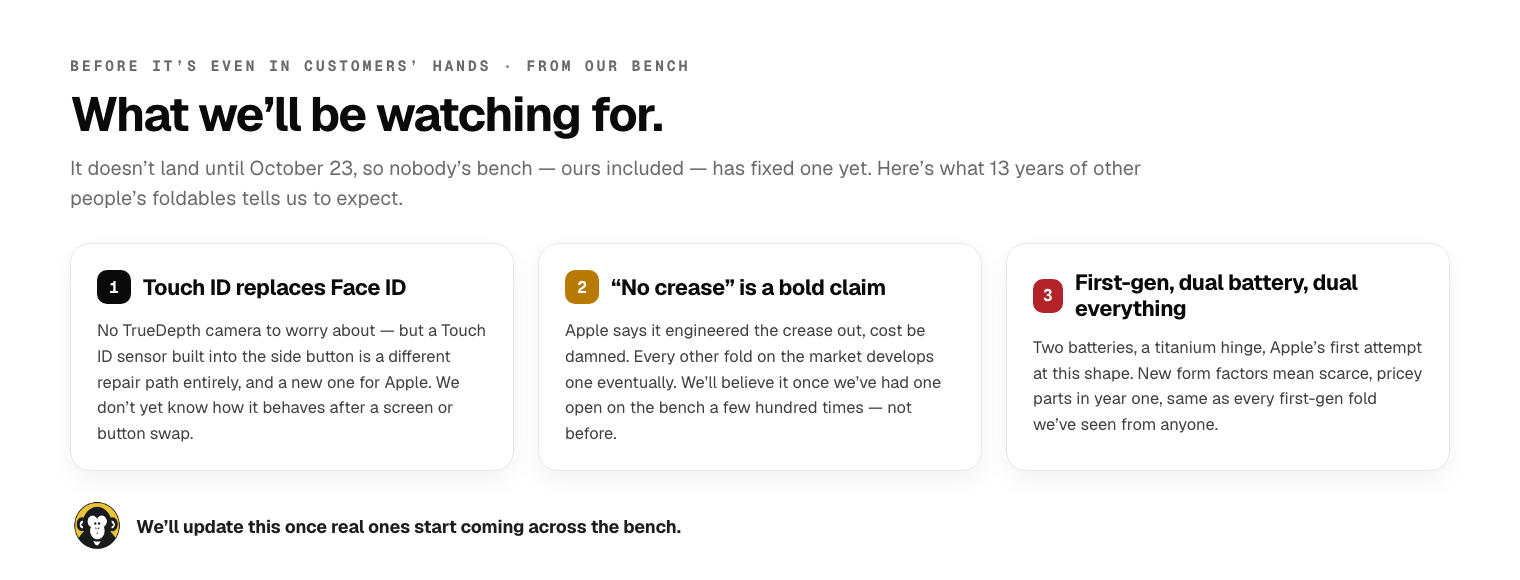
1. A new unlock mechanism means a new repair path
Every Face ID repair we've done since the iPhone X has revolved around the TrueDepth camera array behind the screen. That's gone. In its place is a Touch ID sensor built into the side button — new territory for how a screen replacement, a button replacement, or drop damage near that edge might interact with it. We don't know yet whether it behaves like the old Home button Touch ID (which we can usually transfer across on older iPads) or something more tightly paired to the logic board. We'll find out properly once we've had one on the bench.
2. "No crease" is the boldest claim in the room
Apple says it pursued a crease-free display "regardless of cost." That's a genuinely different engineering approach to what Samsung and others have done, and if it holds up, it's a real advance. But every folding phone we've serviced eventually shows some sign of wear at the fold line — a slight visible line, a soft spot, a place where dust collects. We're not calling Apple's claim false. We're saying a repair bench believes durability claims after a few hundred open-close cycles on a customer's actual phone, not after a keynote demo, and we'll say so honestly either way once we know.
3. First-generation shape, first-generation parts problem
Titanium frame, Ceramic Shield front and back, IP68, dual batteries — on paper this is Apple's most over-engineered phone. None of that changes the pattern every brand-new form factor follows: parts are scarce and expensive in year one, because the supply chain hasn't caught up and few workshops are tooled for a shape nobody's serviced before. If you're the sort of person who's hard on phones, the first twelve months of any new fold — Apple's included — is the most expensive possible time to need an out-of-warranty repair.
So — is it worth it?
If you've been waiting for Apple to make a fold, this is a genuinely serious first attempt: real engineering behind the crease claim, a sensible new take on Touch ID, and specs that don't feel like a compromise next to the iPhone 18 Pro. Whether A$3,499 (and up to A$5,899 for the top tier) is worth it to you is a personal-finances question we're not going to answer for you. What we will say: consider AppleCare+ seriously on a first-gen fold, keep it out of gritty pockets once you've got one, and don't peel anything off the inner screen that looks like a factory protector until you've asked someone who knows.
And when something does eventually need fixing — because on a device this complex, eventually something does — we'll be here. We'll update this post honestly once real ones start coming across our bench. In the meantime, if you've got an older iPhone to move on before the Duo lands, our trade-in will put a real number on it in minutes, and you can always build a repair quote in 60 seconds for anything you're carrying right now. Everything we fix is on the repairs page.
03 9467 9694 · K10, DFO Uni Hill, 2 Janefield Drive, Bundoora · open every day, 10:00am – 6:00pm


Be the first to comment — or if you'd rather just ask us in person, walk in to DFO Uni Hill any day 10–6.