

A bloke put a phone on our counter last week with a crack running corner to corner and a splinter of glass missing near the earpiece. He'd had it like that since Easter. His words: "It still works, so I just haven't bothered." Fair enough — and that's exactly the sentence we hear most often, right before we find corrosion on a display connector.
Here's the honest version, from a bench that replaces a dozen or so screens a week. A cracked screen that still works isn't a screen that's fine. It's a screen that hasn't finished failing yet. Whether that matters to you depends entirely on which kind of crack you've got — so let's sort that out first, because we are not going to tell you every crack is an emergency.
First: how bad is it, really?
Not all cracks are the same job or the same risk. When someone hands us a phone, we're not looking at how ugly it is. We're looking at whether the seal is broken, whether the glass is coming away, and whether the layer under the glass is being flexed.
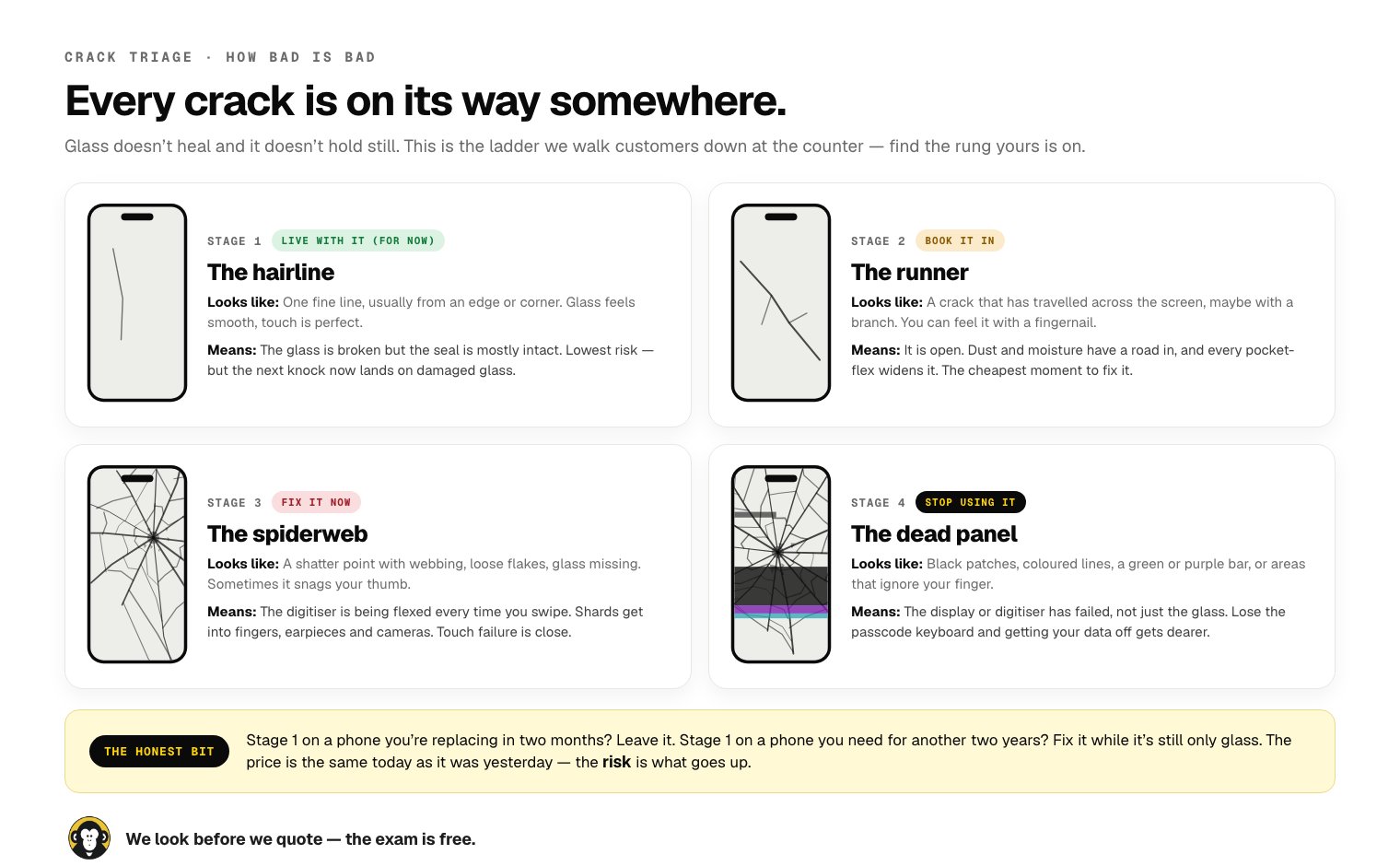
The one people get wrong in both directions is stage 1. Half of you panic about a hairline, and half of you ignore a shatter because "the touch still works." A single hairline from a corner, with smooth glass and perfect touch, is genuinely low risk in the short term. Your phone has lost some structural strength and the next knock will land on already-damaged glass — but there's no crisis this week.
Stage 2 is where it changes. Once a crack has travelled and you can catch a fingernail in it, the screen is open. Not "might be open" — open. And stage 3 is the one to stop putting off, because at that point you're flexing a damaged digitiser every time you scroll, and glass is coming away into fingers, earpieces and camera housings.
Stage 4 — black patches, coloured bars, dead touch zones — is a different conversation entirely, and the urgent part isn't the screen. It's your data. If the touch layer dies before you've backed up, you can't type your passcode, and getting the contents off a locked phone with a dead digitiser is its own job at its own price. Back it up today, not after you've booked the repair.
Why "it's only the glass" stops being true
This is the bit that doesn't show up in the shop window. People picture a phone screen as a pane of glass sitting on top of a picture. It isn't. It's a stack of bonded layers — cover glass, touch digitiser, the OLED panel itself — all glued into the frame with an adhesive seal. The glass isn't decoration. It's the lid.
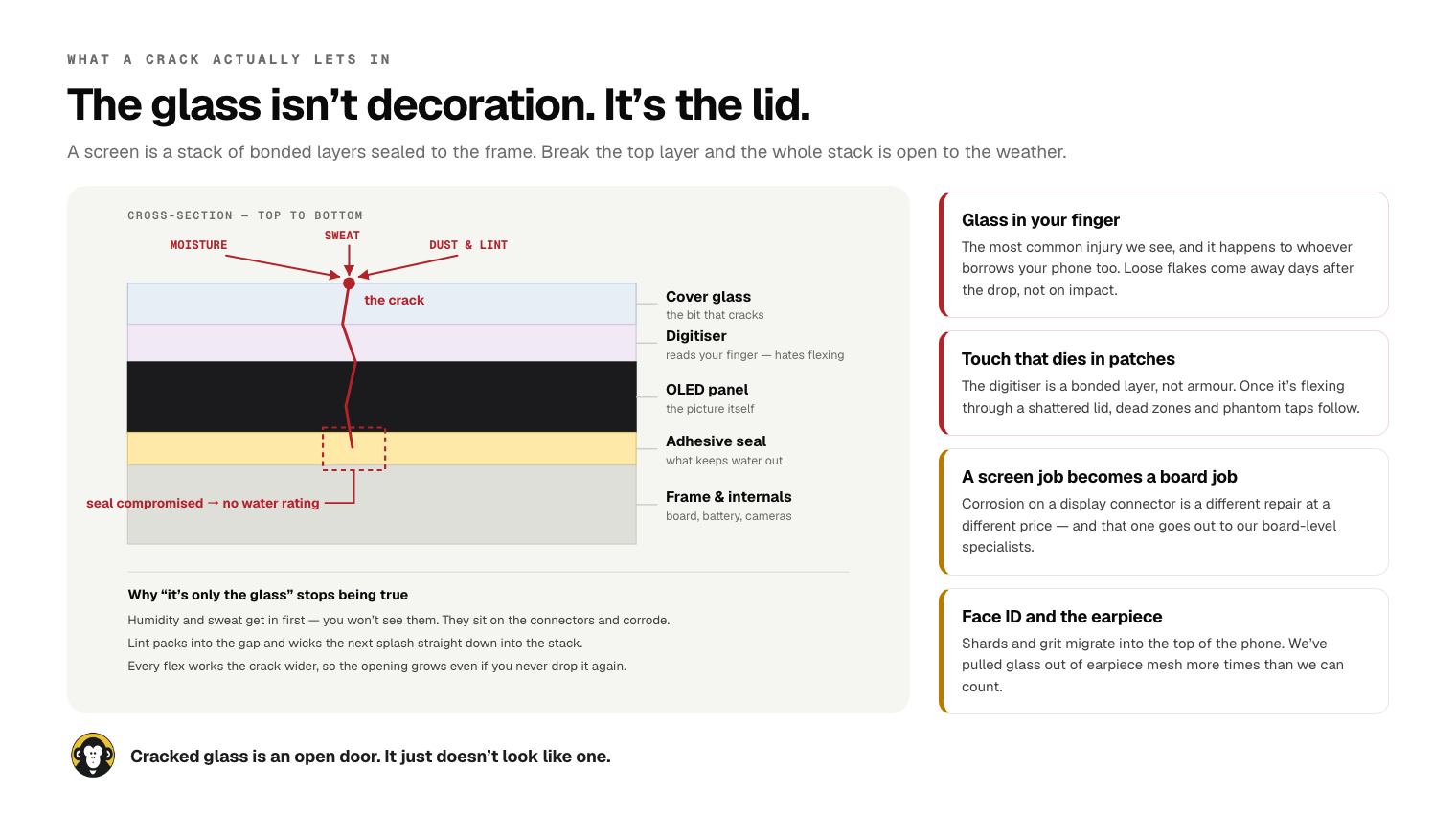
Break the lid and three things start happening quietly.
Moisture, and it isn't dramatic
Everyone imagines water damage as a phone in a toilet. Most of what we see is slower and duller than that: humidity, rain on the walk from the car park, steam in a bathroom, sweat in a gym pocket. It gets into the crack, sits on connectors and starts corroding. Nothing happens on day one. Something happens in week six, and by then nobody connects it to the drop.
And to be very clear about the marketing claim on the box: a phone with cracked glass has no water rating. Not a reduced one. None. Those IP ratings are measured on a sealed, factory-fresh device, and the seal is the first thing a crack destroys.
Dust, lint and the widening gap
A pocket is full of lint, and lint packs into an open crack. That's mostly cosmetic on its own — the problem is that packed lint wicks the next bit of moisture straight down into the stack instead of letting it evaporate off the surface. Meanwhile the phone flexes a fraction every time you sit down with it in your back pocket, and every flex works the crack a little wider. This is why people swear the crack "grew on its own." It did. You just didn't drop it again.
The digitiser gets tired
The touch layer is bonded to the glass, so when the glass is shattered, the digitiser is being flexed and stressed with every swipe. That's where dead zones come from — the strip along the top that stops registering, the keyboard row that misses every third tap, the phantom touches that open apps by themselves while the phone sits on the bench. Once that starts, it doesn't settle down.
Nobody comes in and says "my crack got worse." They come in and say "the touch has gone weird." It's the same story, three months later.
What waiting actually costs
Here's the part worth being straight about, because a lot of repair-shop advice on this is just fear with a price tag attached. Waiting does not make the screen repair more expensive. An iPhone screen costs the same today as it will in March. We're not going to pretend otherwise.
What waiting changes is how many jobs there are by the time you get here.
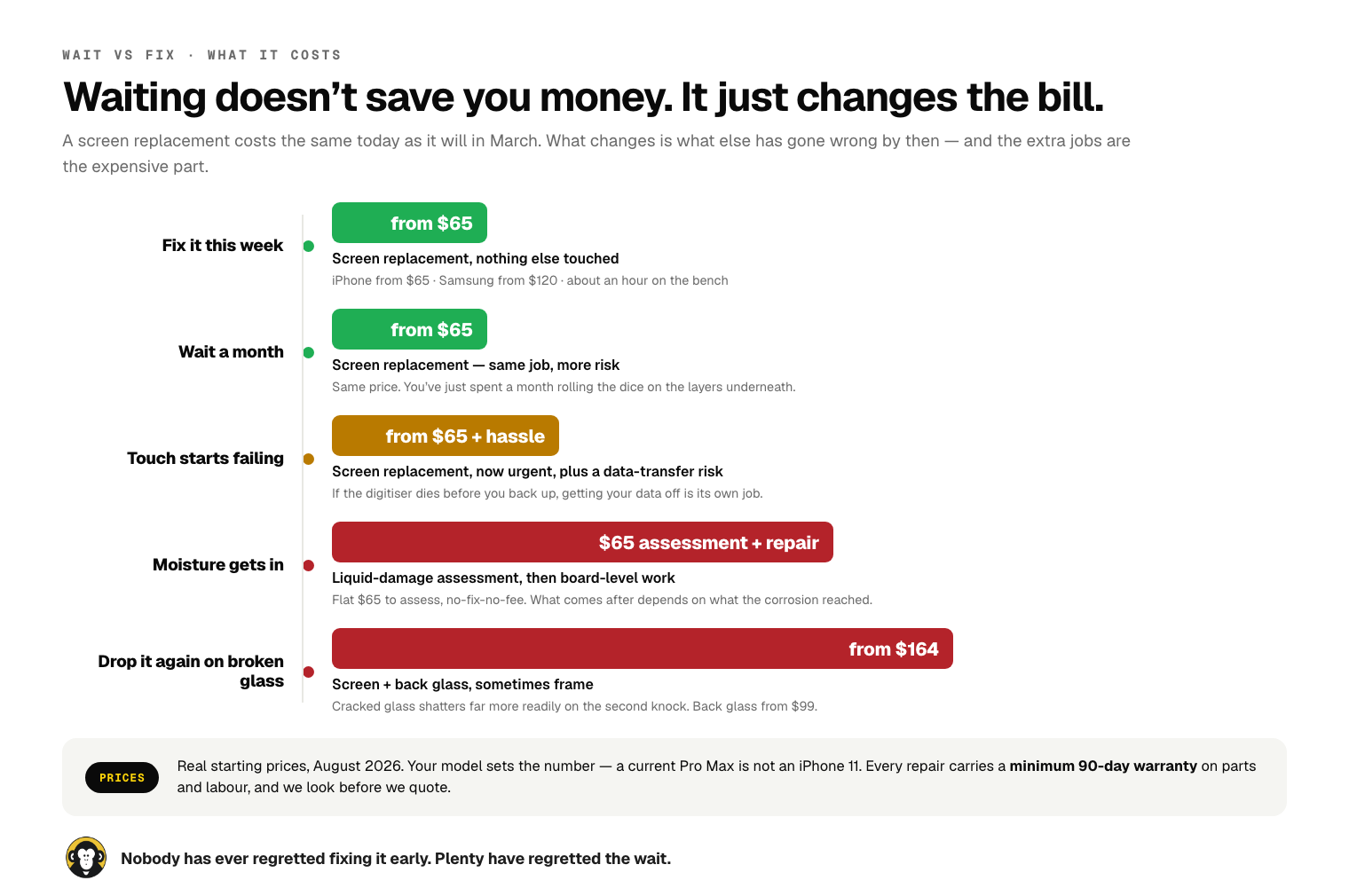
A screen replacement on its own is a clean, quick job. A screen replacement plus corrosion on the display connector is a different repair at a different price — and that one goes out to our board-level specialists rather than being done on our bench in an hour. A screen replacement plus a second drop that took the back glass with it is two jobs. A screen replacement on a phone you can no longer unlock is a screen replacement plus a data problem.
So the maths isn't "fix it now or it gets dearer." It's "fix it now for one price, or roll the dice on whether you're paying for one thing or three." Most people get away with it. The ones who don't, really don't.
When waiting is genuinely the right call
We'd rather say this out loud than have you think we're just drumming up work. There are times leaving it is the sensible decision:
- You're upgrading in a month or two anyway. A stage 1 hairline on a phone that's about to be traded in isn't worth $65 to you — though do check whether the crack knocks more off the trade-in value than the repair costs. Sometimes it does, and then fixing it pays for itself.
- It's a spare, a drawer phone, or a kid's YouTube machine that never leaves the house. No pockets, no rain, no risk. Tape over any sharp edge and get on with your life.
- The phone is genuinely at the end of its life. If it's seven years old, the battery's flat, the port's worn and the screen's shattered, we'll tell you not to spend the money. We've talked plenty of people out of repairs. It's cheaper for us to be honest than to have you back in a fortnight, annoyed.
What isn't on that list: a phone you rely on every day, that lives in a pocket, that goes to work and the beach and the footy with you, with a crack you can feel. That one gets fixed.
What it costs and what actually happens
iPhone screen replacements start at $65 and Samsung starts at $120 — your model sets the real number, because a current Pro Max is not an iPhone 11. Most are about an hour on the bench, and most people walk out the same day. Back glass, if the drop got both sides, starts at $99.
We fit top-tier aftermarket "Soft OLED" panels as standard, which is what roughly nine out of ten customers choose, and we'll order in a genuine Apple service pack display instead if you'd prefer — just ask and we'll walk you through the actual difference. If you want the full breakdown before you decide, we wrote a whole post on what "$89 OLED" really means, and another on what to expect from a screen replacement start to finish.
Every repair carries a minimum 90-day warranty on parts and labour. And we look before we quote — the exam is free. That matters here more than most jobs, because roughly one cracked phone in ten has something else going on underneath that changes the answer: a swollen battery pushing the screen up, early corrosion around the connector, a frame that's bent enough that a new screen won't sit flat. We'd rather find that on the bench and tell you than glue a new screen onto a problem.
If liquid has already got in, that's a different path: a flat $65 assessment, no-fix-no-fee, and an honest answer about what the corrosion reached before we touch anything.
The short version
A crack that still works is a clock, not a verdict. If it's a hairline on a phone you're replacing soon, leave it. If you can catch a fingernail in it, book it in — that's the cheapest, cleanest version of this repair you're ever going to get. If it's webbed, flaking, or the touch has started playing up, don't wait for the weekend after next. And if the display is dying, back your phone up today, before the passcode keyboard goes with it.
Not sure which one you've got? Build a quote in 60 seconds, or just bring it in — we'll put it under the light, tell you what we actually see, and you can decide from there. Everything we fix is on the repairs page.
03 9467 9694 · K10, DFO Uni Hill, 2 Janefield Drive, Bundoora · open every day, 10:00am – 6:00pm


Be the first to comment — or if you'd rather just ask us in person, walk in to DFO Uni Hill any day 10–6.