

Walk past five iPhone repair kiosks in any Melbourne shopping centre and you'll see the same A4 sign: "iPhone screen repair · OLED · from $89." Sounds like a deal. The catch is in the word "OLED."
We've spent 13 years on the bench at DFO Uni Hill, and at least one job a week comes back to us from a kiosk that fitted what they called an "OLED screen" — Face ID dropping out, auto-brightness going haywire, a hairline green line a month in. Almost every time, when we open it up, the panel isn't really OLED. Or if it is, it's a no-name budget panel that was never meant to last more than the warranty window.
Here's the honest version of what "aftermarket OLED" actually means in the Melbourne repair market, the four failure modes that come back to us, the "Unknown Part" warning that's now baked into iOS, and three questions to ask any repairer before you hand the phone over.
What an "aftermarket OLED" actually is — and what's wrong with the cheap ones
There's a lot of grey area in the word "OLED," and the kiosk industry has been exploiting it for years.
A proper aftermarket OLED — what we call Soft OLED — is a real OLED panel made by a third-party manufacturer (not Apple). True blacks, full colour, supports True Tone, feels identical to the original screen. We've vetted the supplier, the panels are calibrated, and we've been running them for years with a sub-1% failure rate. This is what we fit for about 9 out of 10 customers — and we name it on your receipt.
The kiosk problem is what we call budget OLED, and it falls into two buckets:
- Re-labelled Incell. An LCD with the touch layer baked in, sold as "OLED" because most customers can't tell the difference for the first month. iOS will quietly hide the True Tone toggle. Brightness in direct sunlight is half what an OLED does. The blacks are grey.
- No-name budget OLED. A real OLED panel — but from a no-name factory with no calibration, no flex-cable quality control, and no after-sales support. Looks fine for 30 days. Then the auto-brightness sensor goes weird, or a thin green line appears down the left edge.
Both of these get sold as "OLED" at $89. Neither is the same product as a proper Soft OLED — but you can't tell from the shopfront. (Our earlier piece has the full grade-by-grade breakdown if you want the wider picture.)
The four failure modes we see every month from kiosk repairs
When a kiosk-repaired phone lands on our bench for a second go, it's almost always one of these four. We see each at least weekly.
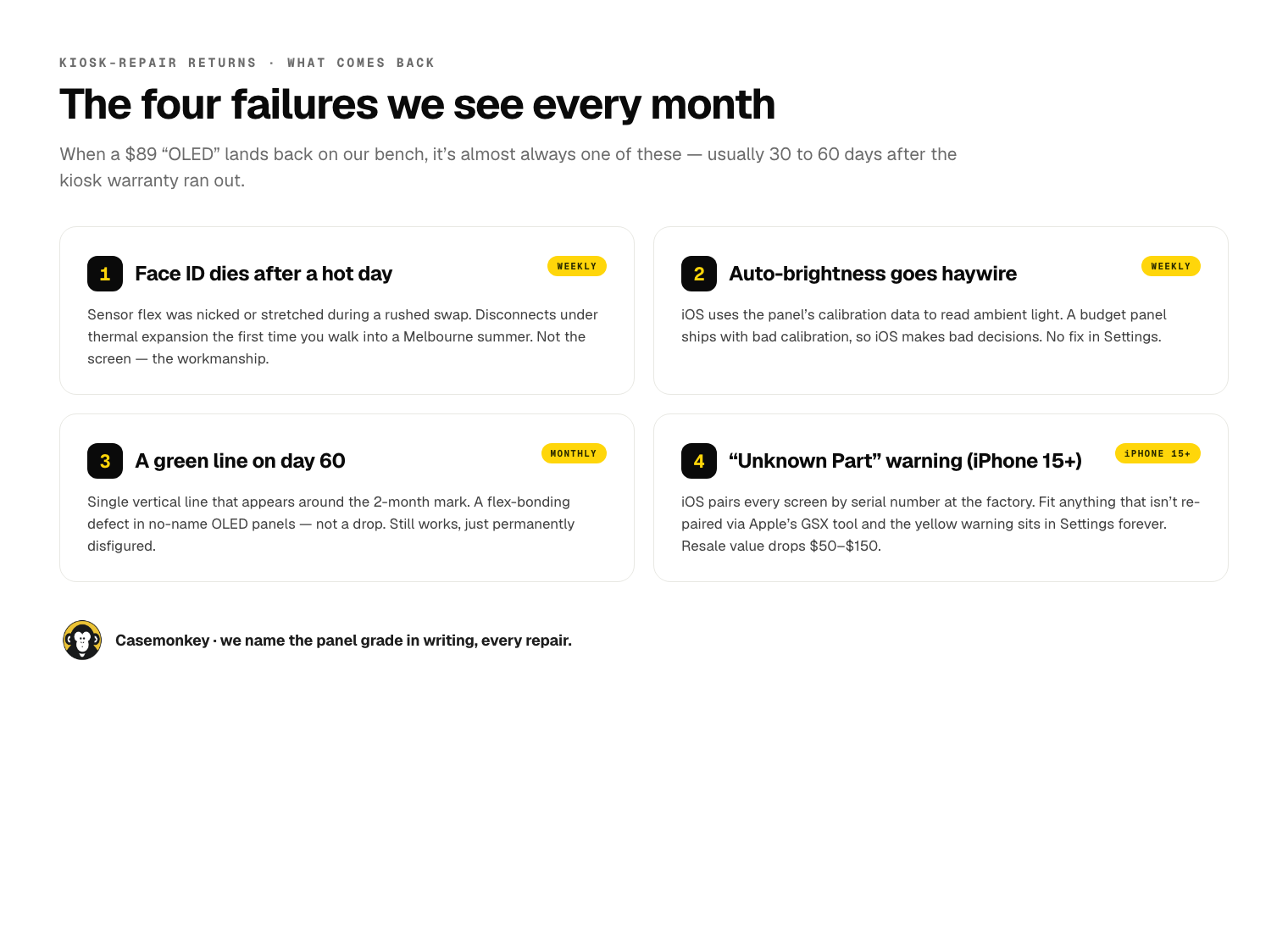
1. Face ID dropout after the first temperature swing. Walk out of an air-conditioned house into a 32°C Melbourne summer day. Suddenly Face ID is asking you to "move iPhone lower" — when nothing about your face has changed. The cause: the front sensor flex was nicked or stretched during a rushed swap, and it now disconnects under thermal expansion. Was never the screen — was the workmanship.
2. Auto-brightness going haywire. Phone bumps brightness to 100% in a dim room, then drops it to 10% under a normal lamp. iOS uses ambient-light-sensor data plus display calibration data; on a budget panel, the calibration data is wrong, so iOS makes bad decisions. There's no fix in Settings — the only fix is fitting a properly calibrated panel.
3. The green line. A single vertical line of pixels — usually green, sometimes white — appears anywhere on the screen and won't go away. On a genuine OLED this is a clear sign of physical impact (a drop). On a budget OLED panel it just happens — a manufacturing defect in the flex bonding that shows up around the 60-day mark. The screen still works. It's just permanently disfigured.
4. The "Unknown Part" warning (iPhone 15+). Settings → General → About now lists every screen Apple recognises. Fit anything other than a genuine Apple part (Service Pack or pulled-from-an-Apple-device) and iOS shows a yellow warning: "Unknown Part." It doesn't break the phone. It does drop your resale value on Marketplace and it sits there as a constant reminder. We'll talk about how we deal with that in a sec.
We back our own repairs against all four of these. The kiosk problem is that when their screen fails this way, the warranty has already run out (usually 30 days, sometimes 7), and the kiosk is now under a different name with different staff.
The "Unknown Part" warning — what Apple is actually doing
Starting with iPhone 12 and accelerating dramatically on iPhone 15 and 16, Apple began chipping each display with a serial number that pairs to the phone's logic board at the factory. When you swap the screen — for ANY reason, including with a brand-new Apple Service Pack panel — the serial numbers no longer match, and iOS posts the "Unknown Part" warning in Settings.
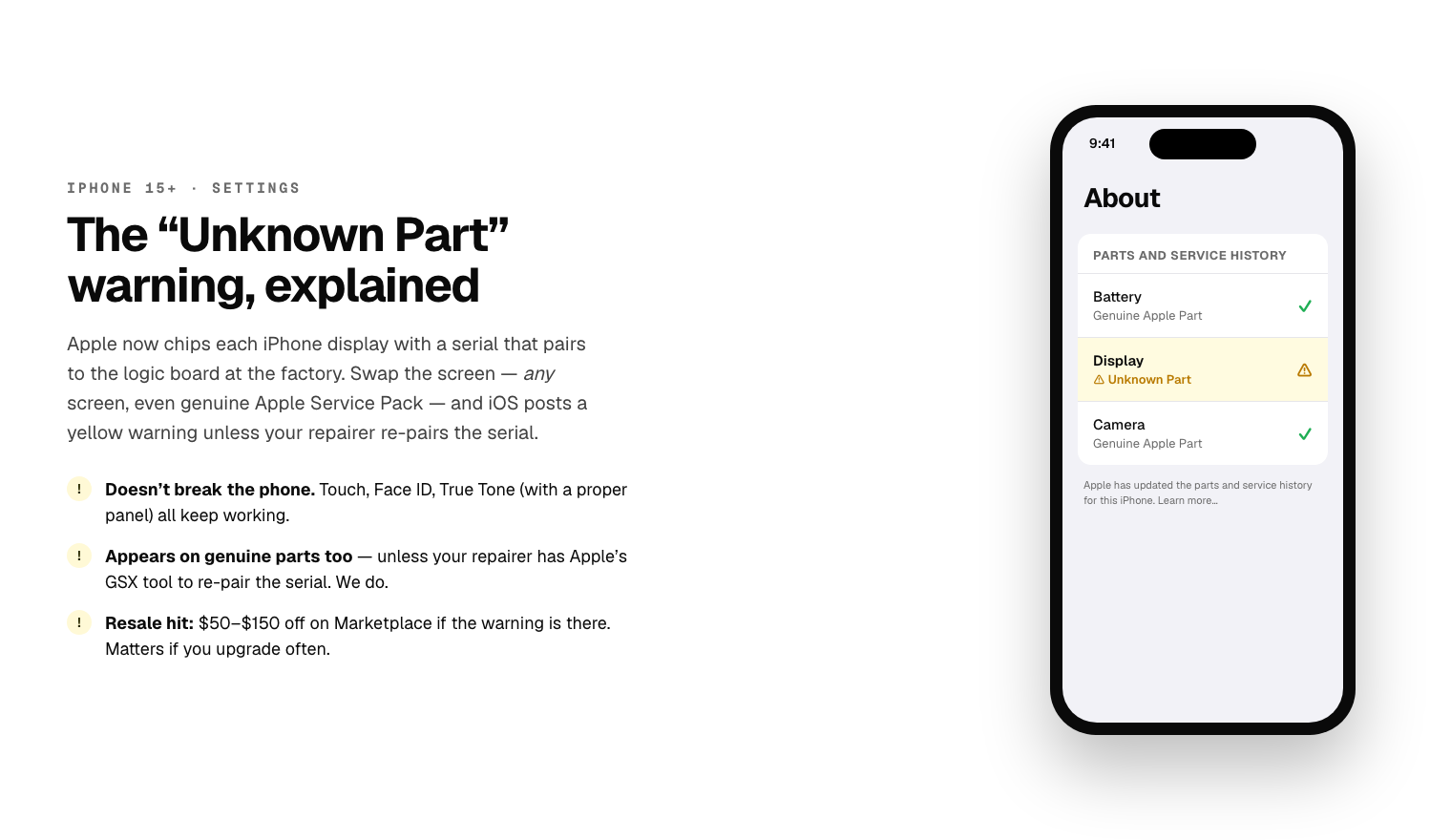
A few honest points about this:
- It doesn't affect the phone working. Touch works, True Tone works (if you fitted a proper panel), Face ID works. It's a notification, not a lockout.
- The warning appears with genuine Apple parts too, unless your repairer has Apple's "GSX" tool to re-pair the serial numbers. We do. We re-pair Service Pack repairs so the warning never appears. For Soft OLED we can't re-pair (Apple won't let us) — so on iPhone 15+ with Soft OLED, the warning sits there.
- Resale value: when you sell on Marketplace or Gumtree, expect $50–$150 off the price if there's an Unknown Part warning. That's real money. For a customer who plans to keep the phone three-plus years, it's a non-issue. For someone who upgrades every 18 months, it matters.
So on iPhone 15 and 16, our recommendation flips: if you're keeping the phone long-term, Soft OLED is still the right call. If you're planning to sell within a year, pay the extra for Service Pack so the warning never appears. We'll ask you which camp you're in before quoting.
Three questions to ask any Melbourne repairer before you hand the phone over
If you're shopping around, here are the three questions that filter the honest shops from the cheap ones. Any shop that won't answer them straight is the answer.
1. "What grade is the panel you're fitting, and is it on the receipt?"
The honest answer is one of these four words: Service Pack, OEM Refurbished, Soft OLED, Incell. Not "OEM," not "genuine quality," not "premium grade." If the shop won't name the grade, or won't write it on the receipt, they're hiding something.
2. "Will the True Tone toggle still work after the repair?"
If they say yes, ask them to write that on the docket. True Tone needs real OLED sensor data — if they're fitting an Incell or a budget OLED with bad calibration, iOS hides the toggle and there's no way to get it back without re-fitting a proper panel. Anyone willing to put it in writing is fitting something that supports it.
3. "If Face ID stops working, who's responsible?"
The honest answer is: "We are, for the warranty period — Face ID flex damage during a screen swap is workmanship, and we'll re-fit a replacement free." If they say "Face ID is unrelated to the screen, that's an Apple problem" — walk out. Face ID damage from a screen swap is the single most common workmanship failure on the bench, and any shop pretending it's not their problem will leave you holding the bag.
We answer all three on every quote. If you want to compare us against a kiosk, ask both of us those questions and see who flinches.
The honest cost difference: why "genuine" is $60 more, not $200
The kiosk pitch is "genuine $300, ours $89, save $200." It's a lie in two directions.
At the kiosk end, the $89 part is almost always Incell, not a real OLED — they're comparing the cheapest grade against Apple's most expensive, and pocketing the gap.
At the genuine end, a real Apple Service Pack screen from a proper repairer in Melbourne is typically $60–$120 more than our Soft OLED — not $200. The $200+ markups are at Apple-direct or licensed-AASP shops, which have overheads we don't.
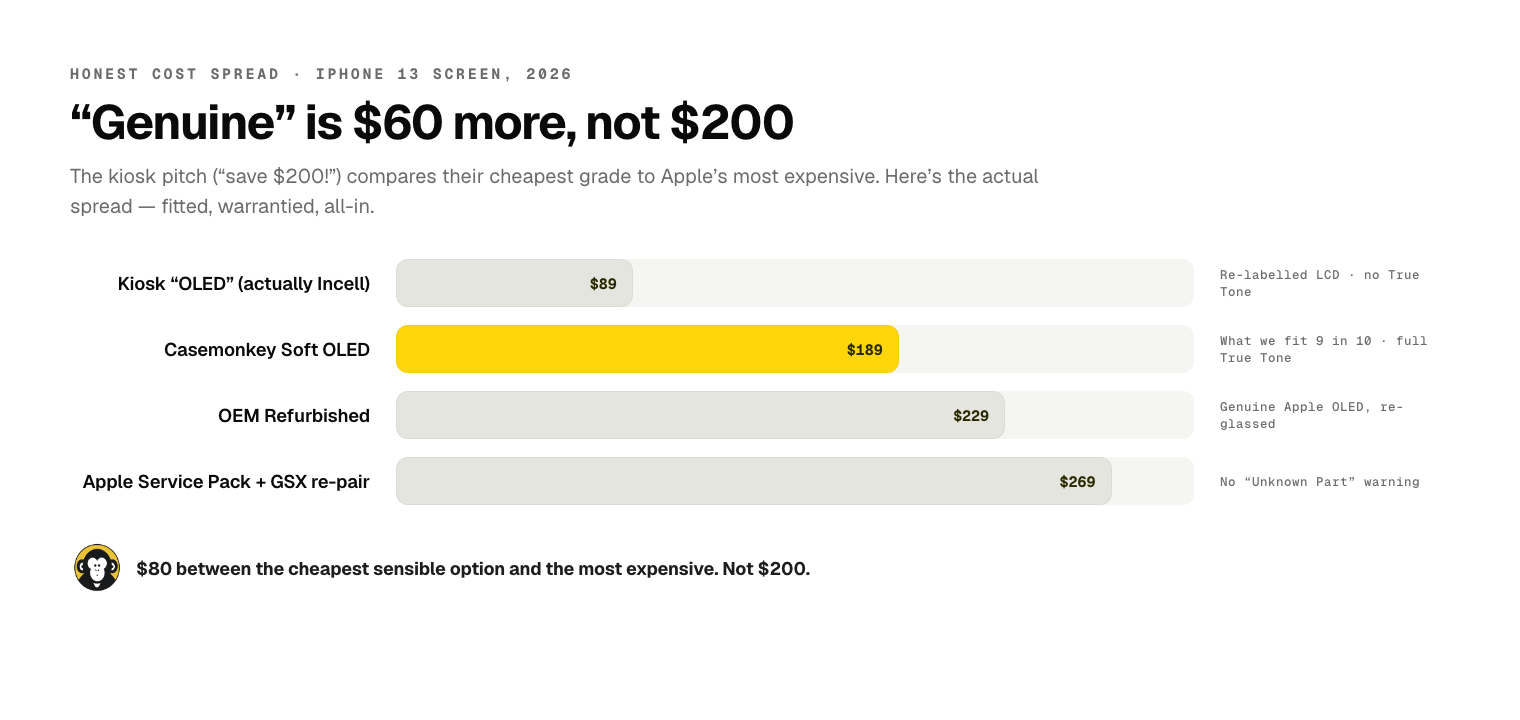
Here's what our 2026 pricing actually looks like on iPhone 13 as an example: Soft OLED is around $189 fitted, OEM Refurbished is around $229, Service Pack with GSX re-pairing (so the Unknown Part warning never appears) is around $269. The whole spread is $80. That's the honest gap between the cheapest sensible option and the absolute most expensive — and the per-model rate card is all public on our pricing page.
So what should you actually pay for?
For most people, on most iPhones, Soft OLED is the right call. It's a proper OLED, True Tone works, it looks identical to the original, it costs 30–40% less than the Apple Service Pack equivalent, and it comes with our minimum 90-day warranty.
The two exceptions:
- iPhone 15 / 16 and you'll resell within a year: Service Pack with GSX re-pairing, so the Unknown Part warning never appears. Costs an extra $60–$80, saves you $100+ on resale.
- Critical work device or insurance claim: Service Pack, because most insurers explicitly require manufacturer-equivalent parts and we extend our warranty to 12 months on Service Pack repairs anyway. (See our insurance claim guide for the assessor checklist.)
For everyone else — the customer who just wants the phone working properly and isn't planning to sell next month — Soft OLED is the right answer, and you should be paying around 30% less than the Apple Service Pack quote, not 60% less. If a shop is offering "OLED" for $89 on a current-model iPhone, the part is not what they're calling it.
That's the whole pitch. We name the grade on the receipt, the warranty is in writing, and the quote you build online is the price you pay at the counter. Walk in to DFO Uni Hill any day between 10 and 6, or build a quote in 60 seconds before you leave the house.
03 9467 9694 · K10, DFO Uni Hill, 2 Janefield Drive, Bundoora · open every day, 10:00am – 6:00pm


Be the first to comment — or if you'd rather just ask us in person, walk in to DFO Uni Hill any day 10–6.