

You've cracked your screen. You've Googled "iPhone screen replacement Melbourne," and now you're staring at a wall of shops all promising the same three things: cheap, fast, genuine. Two of those words mean something. One of them is almost always a lie.
We've been replacing iPhone screens at DFO Uni Hill for 13 years. Here's the honest version of what happens when you bring one in — what you're actually paying for, how long it really takes, and the four traps that catch people comparing quotes around Melbourne.
What "genuine Apple display" actually means (and how to spot the lie)
Walk into ten Melbourne phone shops and at least seven will tell you they fit "genuine" screens. Most of them are bending the truth, because "genuine" has a specific meaning and a vague one, and they're banking on you not knowing the difference.
There are really four grades of replacement panel on the market:
- Service Pack — the actual part Apple ships to its own authorised repairers, in a sealed Apple box. Identical part number, identical everything. The only screen that's truly "genuine." It's also the most expensive — often two to three times the price of the next grade down.
- OEM Refurbished — a genuine Apple OLED that was harvested from another device, had fresh glass laminated over it, and recertified. The OLED itself is 100% Apple; the glass and bond are new.
- Soft OLED — a high-grade aftermarket OLED. Not Apple-made, but a proper OLED panel with excellent colour and brightness. This is what we fit for about 9 out of 10 customers — it looks and feels like the original at a price that makes sense.
- Incell LCD — the cheapest screen going. A hardened LCD with the touch layer baked in. It'll get your phone working, but you'll feel the compromises every day: dimmer, worse colour, no True Tone.
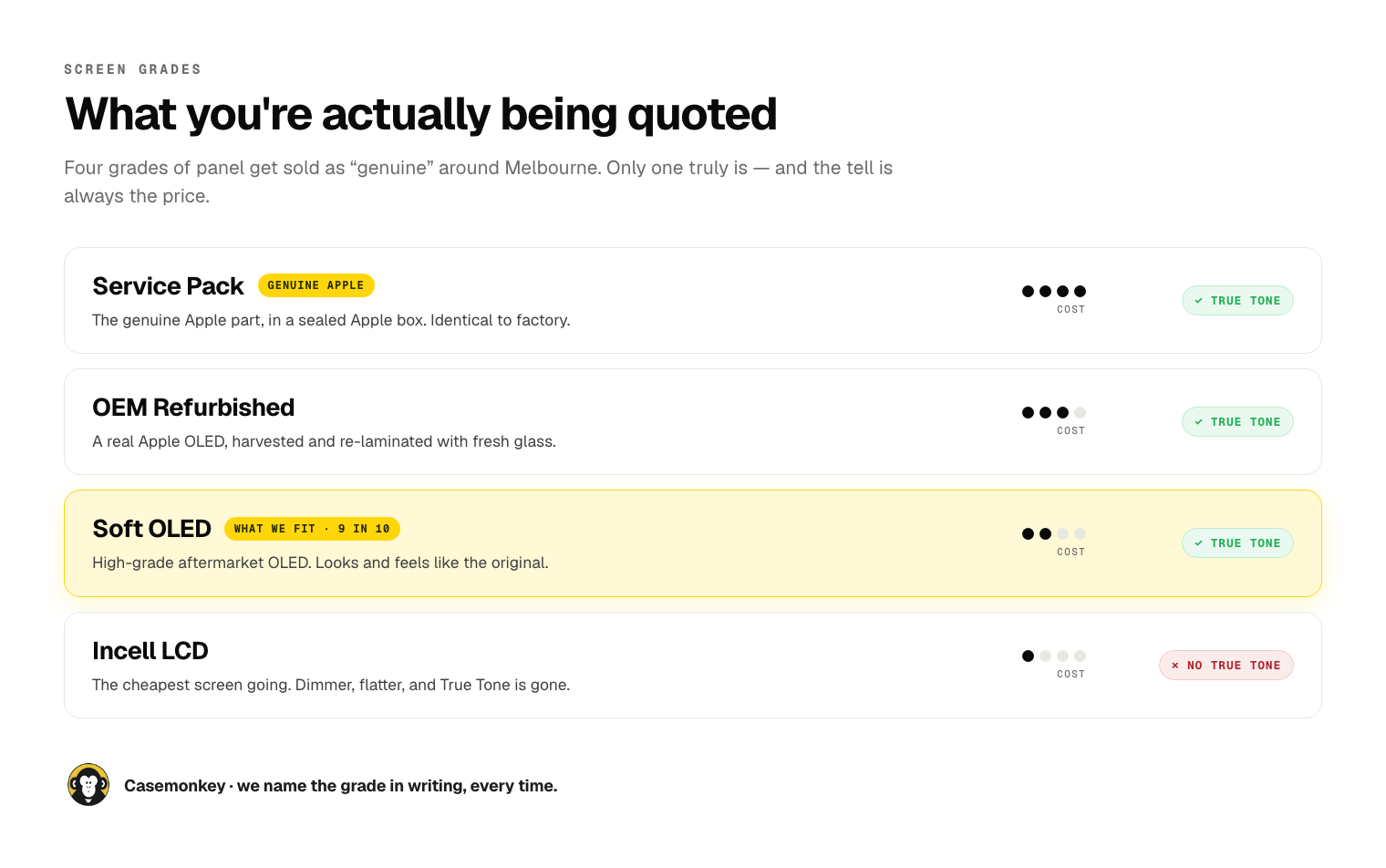
When a shop quotes you a suspiciously low price for a "genuine" screen, they're almost always fitting Incell or a low-grade Soft OLED and calling it genuine. The tell is the price. A real Service Pack panel for a recent iPhone costs the shop a lot — if the quote is cheap, the part is cheap, full stop.
We'll tell you exactly which grade we're fitting before we touch your phone, and it's written on your receipt. If you want the sealed-Apple-box part, we'll order it. If you want the sensible option that 90% of people pick, that's Soft OLED. We don't quietly swap one for the other. Here's the full grade-by-grade breakdown.
Why prices differ by $80 between Melbourne shops for the same job
Two shops, same iPhone model, $80 apart. How?
It comes down to four things, and only one of them is "they're ripping you off":
- The panel grade (above). An Incell screen and a Service Pack screen for the same phone can differ by $400+ at cost. A shop quoting the low number isn't necessarily dishonest — they might just be fitting the cheaper part. The dishonesty is calling it something it isn't.
- Labour and skill. Swapping a screen properly means transferring the Face ID flex, the earpiece mesh, the proximity sensor and the bracket without nicking anything. A shop that rushes it — or skips the transfer and fits a screen that breaks Face ID — saves time and charges less. You pay later.
- Warranty. A shop offering no warranty, or a 7-day one, can afford to be cheaper. We back our work for a minimum of 90 days, parts and labour. Genuine Apple parts carry Apple's own 12-month warranty on top.
- Overheads honesty. Some quotes are "from $X" and balloon when you arrive. Ours don't — the quote you build online is the price, and if we open it up and the real cost is different, we text you for approval before doing anything. Build one here.
If you want to see where we land before you come in, the whole rate card is public. No "call for pricing," no surprises at the counter.
How long it really takes — by model, in 2026
"60 minutes while you wait" is plastered on every shopfront in Melbourne. For a lot of iPhones, it's genuinely true. For some, it's a flat-out lie that leaves you sitting in a food court for three hours.
Here's the honest breakdown:
- iPhone 11 through iPhone 14 (standard + Plus): 45–60 minutes, while you wait. Grab a coffee, it'll be done before it's cold.
- iPhone 12 / 13 / 14 Pro and Pro Max: Closer to 60–90 minutes. The Face ID and camera assemblies are more fiddly and we won't rush the transfer.
- iPhone 15 / 16 series: Same-day, usually 60–90 minutes. Newer bonding and brackets, slightly more careful work.
- Older (iPhone X, XR, XS, SE): Often the fastest — 30–45 minutes.
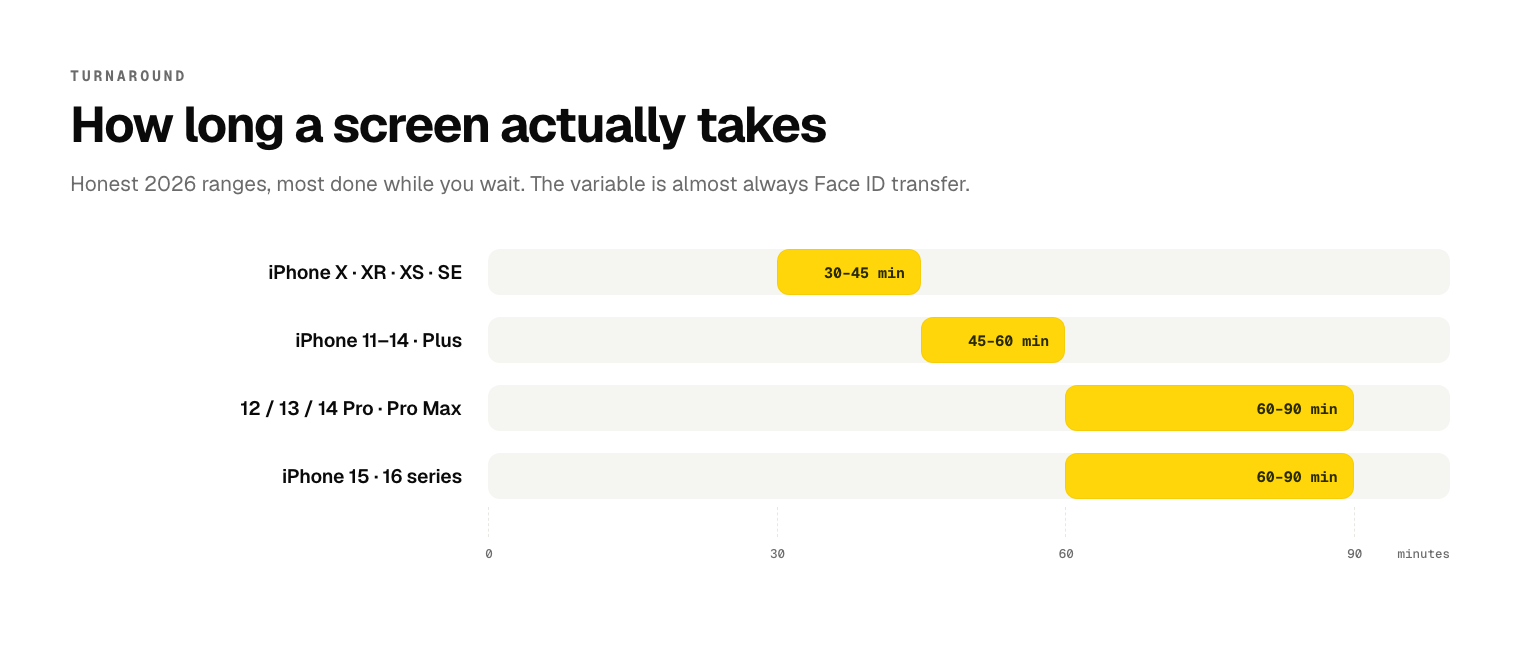
The variable is almost always Face ID transfer. On Pro models the front-sensor assembly is more involved, and any shop telling you a 14 Pro Max is a guaranteed 30-minute job is either very optimistic or about to do it badly. We'd rather take the extra 20 minutes and hand it back working properly.
Most days we can do it on the spot — we're open 10am to 6pm, every day, no appointment needed for a phone screen.
The Face ID / True Tone trap most shops won't warn you about
This is the one that turns a cheap repair into an expensive lesson, so read this bit even if you skim the rest.
Face ID does not live in your screen. The dot projector and TrueDepth camera live in the phone's chassis, not the display. So a screen replacement — done properly — should never break Face ID. If a shop hands your phone back and Face ID no longer works after "just a screen," they damaged the sensor flex during the swap. That's a workmanship problem, not an Apple limitation. We test Face ID before you walk out.
True Tone is different, and it's where the cheap screens bite. True Tone — the feature that warms your display to match the room — needs specific OLED sensor data. Fit a cheap Incell LCD and iOS simply hides the True Tone toggle, because the hardware can't support it. The screen "works," but it's permanently cooler and flatter, and you can't turn the feature back on. A lot of people don't notice until weeks later when their phone looks subtly wrong next to a mate's.
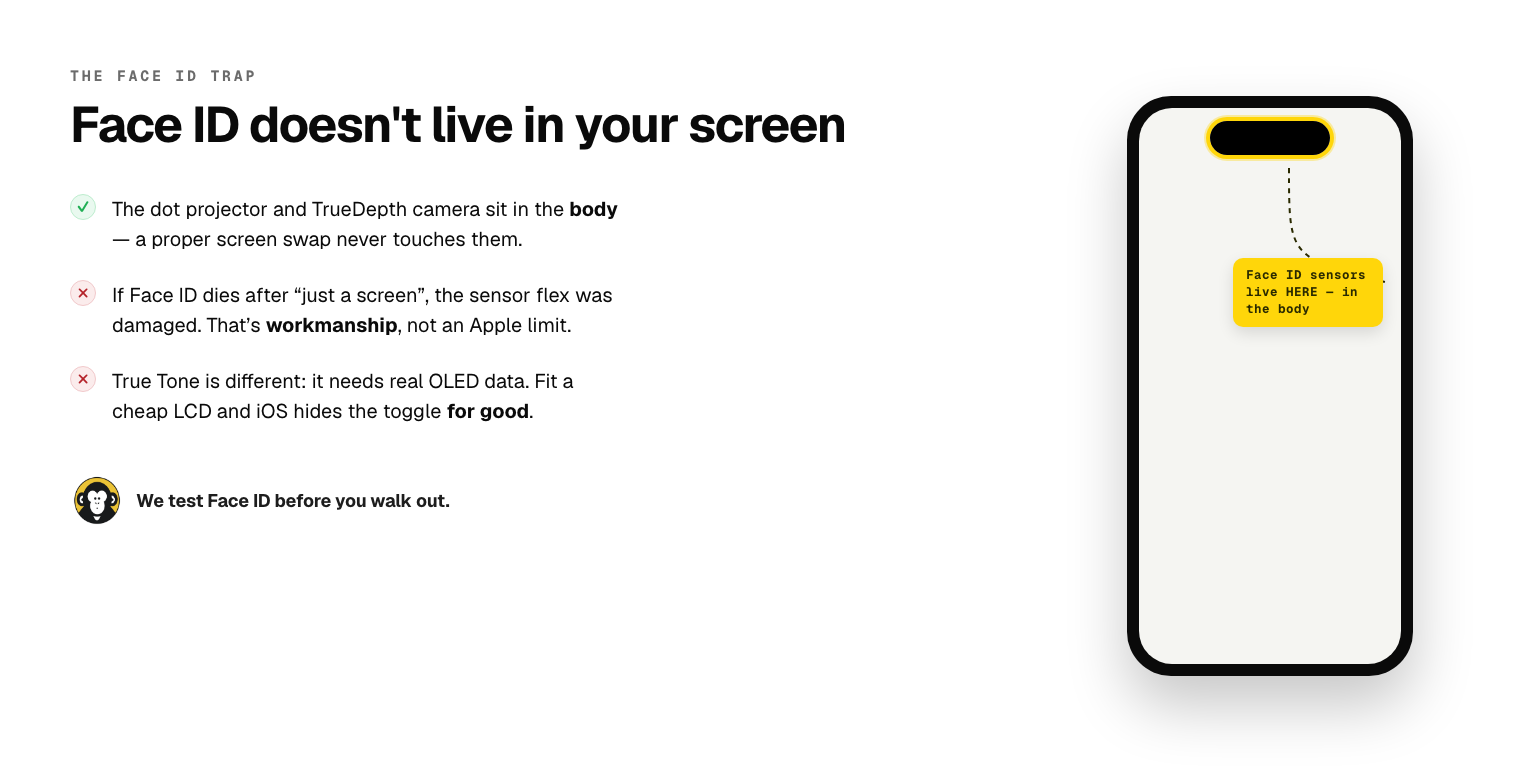
This is exactly why we steer most people to Soft OLED, not Incell — you keep True Tone, you keep the proper OLED look, and you don't pay Apple's Service Pack premium. If you specifically want Incell to save a few dollars, we'll fit it — but we'll tell you what you're giving up first. We'd rather lose the sale than fit one without warning you.
What about water resistance?
Every iPhone from the 7 onwards is water- and dust-resistant from the factory, sealed shut with adhesive around the display. Opening it to replace the screen breaks that seal — there's no way around it, on any repair, at any shop.
So on every model that has a seal, we always reseal it with genuine Apple Service Pack seals — the same adhesive gaskets Apple's own technicians use, fitted the same way. We don't cut corners with generic tape.
Here's the honest part, because no responsible repairer can promise otherwise: a reseal done by hand on a bench can't be pressure-certified the way a sealed factory line can. We get it as close to factory as it's physically possible to be — but we won't guarantee your original IP68 rating fully returns, because the process is manual. Treat a repaired phone as splash-resistant, not swim-proof. If water resistance is genuinely critical for you, that's worth knowing before any repair — ours or anyone else's.
What our 90-day warranty actually does (and doesn't) cover
Warranties on screen repairs are where the fine print does the heavy lifting, so here's ours in plain English.
What's covered (minimum 90 days, parts and labour):
- The screen itself failing — dead pixels, touch dropping out, backlight dying. If the panel's faulty, we re-fit a new one free.
- Our workmanship — if something we touched during the repair stops working (earpiece, Face ID flex, proximity sensor), that's on us.
- Genuine Apple Service Pack parts carry Apple's full 12-month manufacturer warranty in addition to ours.
What's not covered:
- New damage. If you drop it again and re-crack the glass, that's a new repair — physical damage isn't a warranty fault. (We'll always look at it and tell you straight, though.)
- Impact damage to the OLED — a green tint, green lines, or black "ink" spreading across the display. That's a knock or pressure crack to the panel, not a manufacturing fault, so it's a new repair rather than a warranty claim.
- Restored water resistance. We reseal with genuine Apple Service Pack seals, but the original IP68 rating can't be guaranteed after a manual reseal (see above).
- Liquid damage after the fact.
- Screens fitted by someone else. If another shop's repair failed, we'll happily diagnose and re-do it — but we warranty our own work, not theirs.
If something does go wrong inside the window, bring it back and we'll sort it — and we extend the warranty appropriately so you're not left short. That's the whole point of having one.
So — where should you actually get it done?
Look for three things when you compare Melbourne shops:
- They tell you the panel grade in writing. If they won't name it, assume it's the cheap one.
- The quote doesn't move. "From $X" that changes at the counter is a red flag.
- A real warranty, in writing. 90 days minimum. Anything shorter tells you what they think of their own work.
That's how we run it, and it's why people keep coming back 13 years later. If you want a price before you leave the house, build a quote in 60 seconds — pick your model, pick the grade, get the number. Or just walk in to DFO Uni Hill any day between 10 and 6 and we'll have it done while you wait.
03 9467 9694 · K10, DFO Uni Hill, 2 Janefield Drive, Bundoora · open every day, 10:00am – 6:00pm


Be the first to comment — or if you'd rather just ask us in person, walk in to DFO Uni Hill any day 10–6.