

The rumour that won't die is finally getting specific: Apple is expected to launch its first folding iPhone in September 2026, most likely alongside the iPhone 18 line. People are calling it the "iPhone Fold" or "iPhone Ultra." Apple has confirmed absolutely none of it.
We're a repair bench, not a rumour blog — but we're the ones who'll be fixing these when they start folding the wrong way, so we read the leaks with a particular eye. Here's the honest round-up: what the reports actually agree on, what's still a single dodgy source, what it's tipped to cost in Australia, and whether we'd tell a mate to buy one.
What the leaks actually agree on
There's a real difference between "widely reported by people with a track record" and "one account on the internet said so." We've sorted the current crop into firm, shaky, and genuinely unknown.
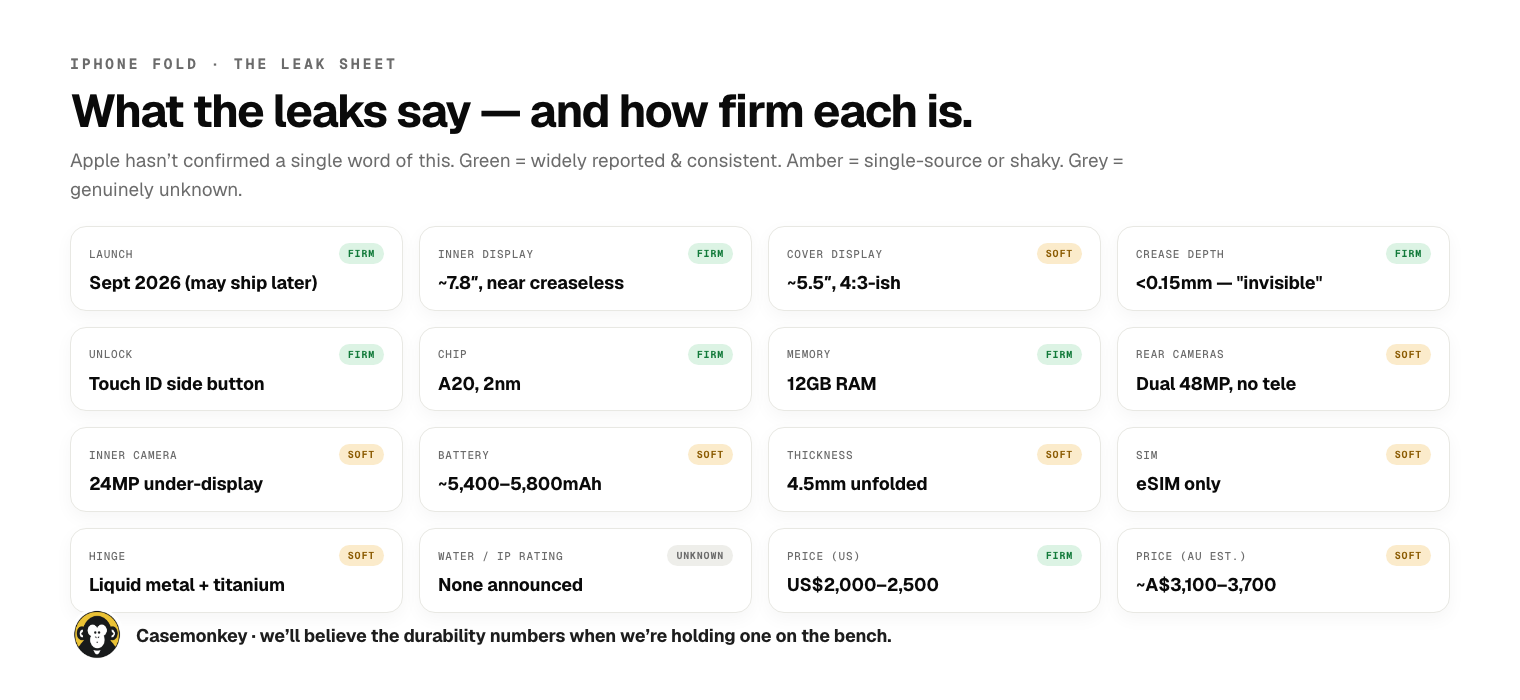
The stuff that shows up consistently across the serious supply-chain reporting: a book-style fold with an inner screen around 7.8 inches, a return of Touch ID in the side button (Face ID's depth sensor is hard to fit in something this thin), Apple's next-gen A20 chip on a 2nm process, and 12GB of RAM. Pricing lands firmly in the US$2,000–2,500 band. Those are the bits we'd bet on.
The shakier stuff — exact camera counts, the battery size, the 4.5mm thickness, eSIM-only with no physical SIM tray, the liquid-metal hinge — is plausible but single-source or still moving. And the one that matters most to us is a total blank: there's no announced water or dust rating at all. On a device with a mechanical hinge, that silence is the loudest thing on the sheet.
The headline trick: a crease you can't see
The reason this phone is interesting isn't the fold — Samsung's done that for years. It's that Apple reportedly refused to ship the visible crease that every folding phone has down the middle. Leakers say Apple chased a creaseless display "regardless of cost," developing a new material and getting the measured crease depth under 0.15mm — effectively invisible in the hand. The hinge is said to use liquid metal, which is tougher and more spring-back than the titanium alloys everyone else uses.
If they've pulled it off, it's a genuinely impressive bit of engineering. But here's the bench-side asterisk: "no visible crease" is not "no fold stress." The inner screen is still a flexible plastic-topped OLED bending around a radius a few hundred thousand times over its life. Making the crease invisible doesn't make the panel less fragile — and it's a brand-new material on its first outing at scale. We've watched a lot of "revolutionary" first-generation display tech become "known issue" by year two.
Every folding phone's weakest point is the same: a soft screen that bends. Hiding the crease is a design win. It isn't a durability win.
What it might cost in Australia
This is the part that'll make your eyes water. Apple hasn't announced pricing, but converting the analyst US estimates and rounding for our market:
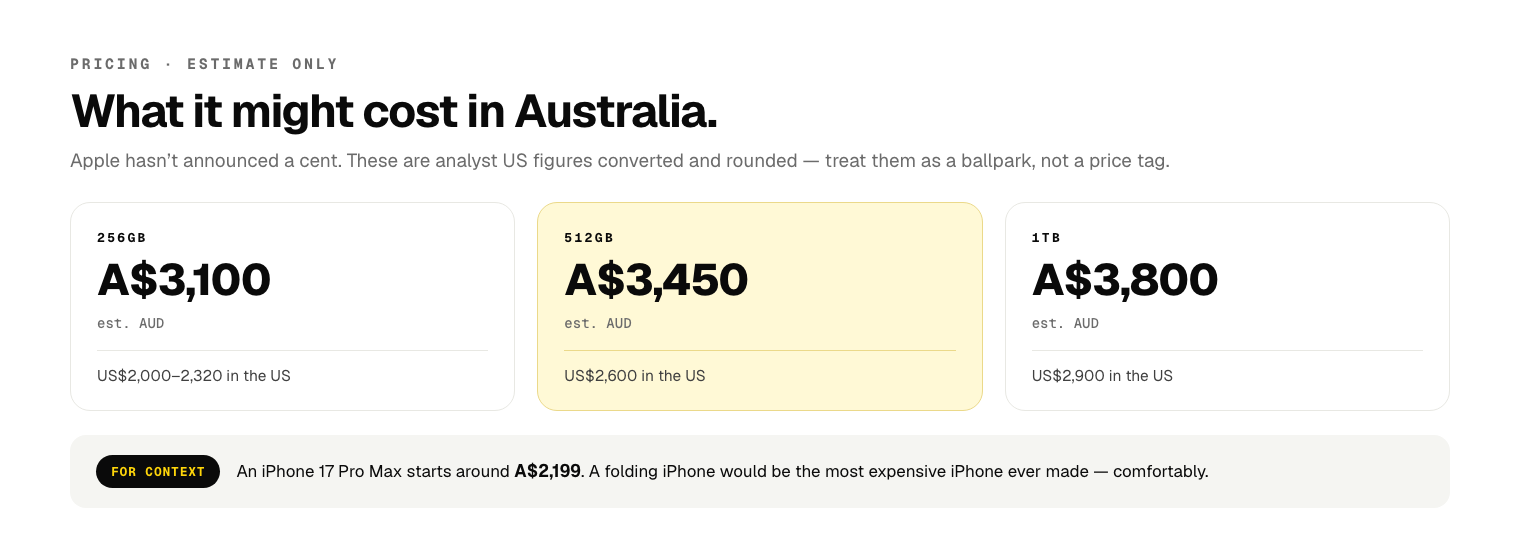
So you're looking at somewhere north of A$3,100 to start, and comfortably past A$3,700 for the big-storage version — making a folding iPhone the most expensive iPhone Apple has ever sold, by a distance. For comparison, a current iPhone 17 Pro Max starts around A$2,199. You're paying a four-figure premium for the hinge.
At that price, a couple of things follow automatically. AppleCare+ stops being optional. And the second-hand and trade-in maths gets interesting fast — if you're the type who upgrades yearly, the depreciation on a A$3,500 phone is a real number. (When the time comes, our trade-in will take your current phone off the price of whatever you move to.)
The repair-bench take
We fix Apple's mistakes for a living, so we read a first-generation anything a little differently to the launch-day reviewers. Three things sit front of mind:
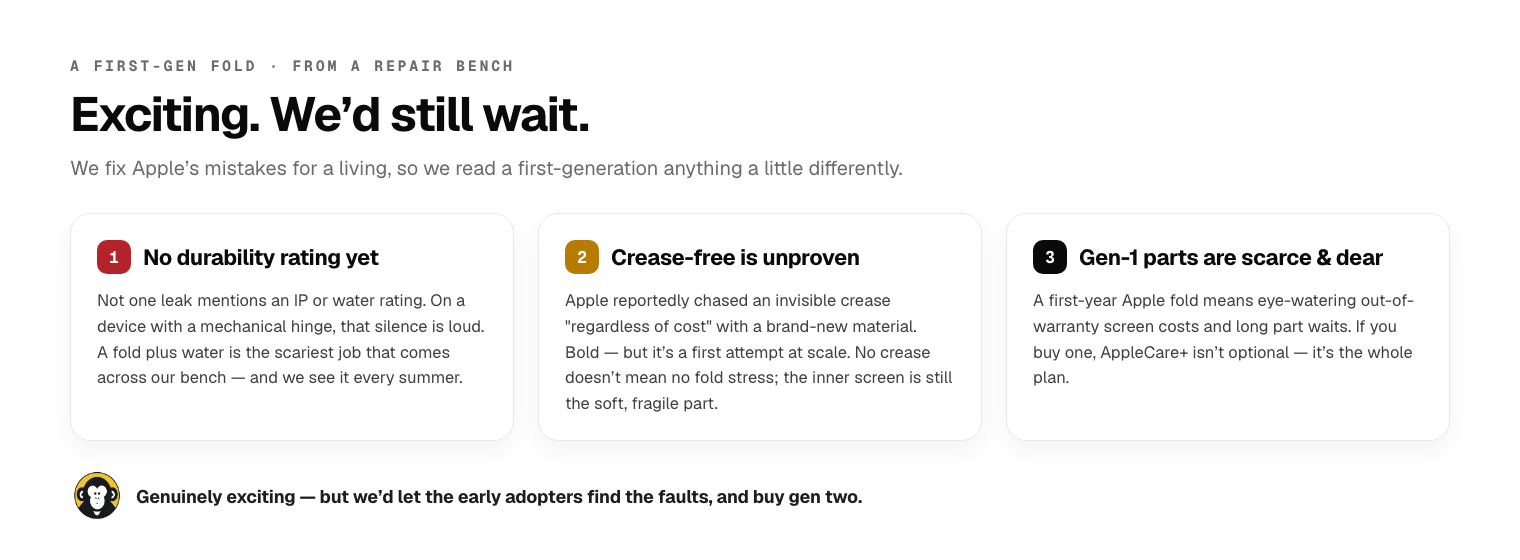
No durability rating, on a phone with a hinge. A fold plus water is the single scariest job that crosses our bench — water gets into the hinge gap and doesn't come back out, and corrosion starts within hours. Until Apple publishes an IP rating we'd treat a foldable iPhone as not water resistant and keep it well away from the pool, the beach and the bathroom sink. If one ever does go under, the drill is the same as any phone: power it off, don't charge it, and get it assessed fast — our water-damage assessment is a flat A$65 and on a fold it's the difference between a clean-up and a write-off.
Gen-one parts are scarce and dear. A brand-new form factor from Apple means replacement inner screens will be expensive and back-ordered for the first year, and very few shops will be tooled up for it early. That's true of every redesign; it's doubly true of a first-ever fold. If you must be an early adopter, budget for it.
Our honest verdict? It's genuinely exciting, and Apple entering the fold market late usually means they've waited for the tech to mature. But a first-generation folding phone at A$3,500, with no published durability rating, is a lot of faith to put in a brand-new material. If it were our money, we'd let the early adopters find the faults and buy the second generation. If you've read our take on Samsung's new Fold8, you'll know we say the same thing about every fold: brilliant to use, expensive to fix, treat the crease like the moving part it is.
If you're buying one anyway
Fair enough — new toys are fun. Three practical notes. Touch ID is back, so if you've got used to Face ID unlocking as you lift the phone, that's a small adjustment. eSIM-only (if the leaks hold) means no physical SIM tray — worth knowing before an overseas trip where you'd normally pop in a local SIM. And get the AppleCare+; at this price it's not insurance, it's part of the purchase.
When these do land, we'll service them the same way we do every other phone: an honest, free look before any quote, original parts, and a straight answer about whether it's worth fixing. Until then, we're already the bench for Samsung's folds and everything else — build a quote in 60 seconds, or see the full list on our repairs page.
03 9467 9694 · K10, DFO Uni Hill, 2 Janefield Drive, Bundoora · open every day, 10:00am – 6:00pm


Be the first to comment — or if you'd rather just ask us in person, walk in to DFO Uni Hill any day 10–6.